
Manufacturing companies across Southeast Asia are shutting down on-premise data centres and moving critical business systems to the cloud. This isn’t a gradual trend anymore. It’s a full-scale migration driven by real operational pressures, competitive threats, and the need to operate across multiple countries without the overhead of traditional infrastructure.
Cloud ERP adoption in Southeast Asia is accelerating because manufacturers need real-time visibility across multiple sites, faster scaling without capital expenditure, and better compliance management across diverse regulatory environments. The region’s infrastructure improvements, competitive vendor pricing, and government digitalisation incentives have made cloud systems more practical and affordable than maintaining legacy platforms. Companies that switch report faster deployment times, lower total cost of ownership, and better agility during supply chain disruptions.
What’s driving the shift to cloud ERP in Southeast Asian manufacturing
The manufacturing sector in Southeast Asia faces unique operational challenges that legacy systems simply can’t address anymore.
Multi-country operations create complexity. A manufacturer with facilities in Thailand, Vietnam, and Indonesia needs to manage different tax codes, labour regulations, and reporting requirements. Traditional ERP systems require separate instances for each location, creating data silos and forcing finance teams to manually consolidate reports.
Cloud platforms handle this differently. They support multiple currencies, tax jurisdictions, and compliance frameworks within a single system. Your team in Bangkok sees real-time inventory data from your Hanoi warehouse. Your CFO in Singapore can generate consolidated financial statements without waiting for month-end spreadsheet exercises.
Supply chain volatility has also changed the game. When shipping routes get disrupted or raw material costs spike, you need to see the impact immediately and adjust production schedules accordingly. On-premise systems often run batch updates overnight. By the time you see yesterday’s data, market conditions have already shifted.
The cloud ERP vs on-premise decision now favours cloud for most mid-sized manufacturers because deployment speed matters more than ever.
Cost realities that make cloud ERP attractive for regional manufacturers
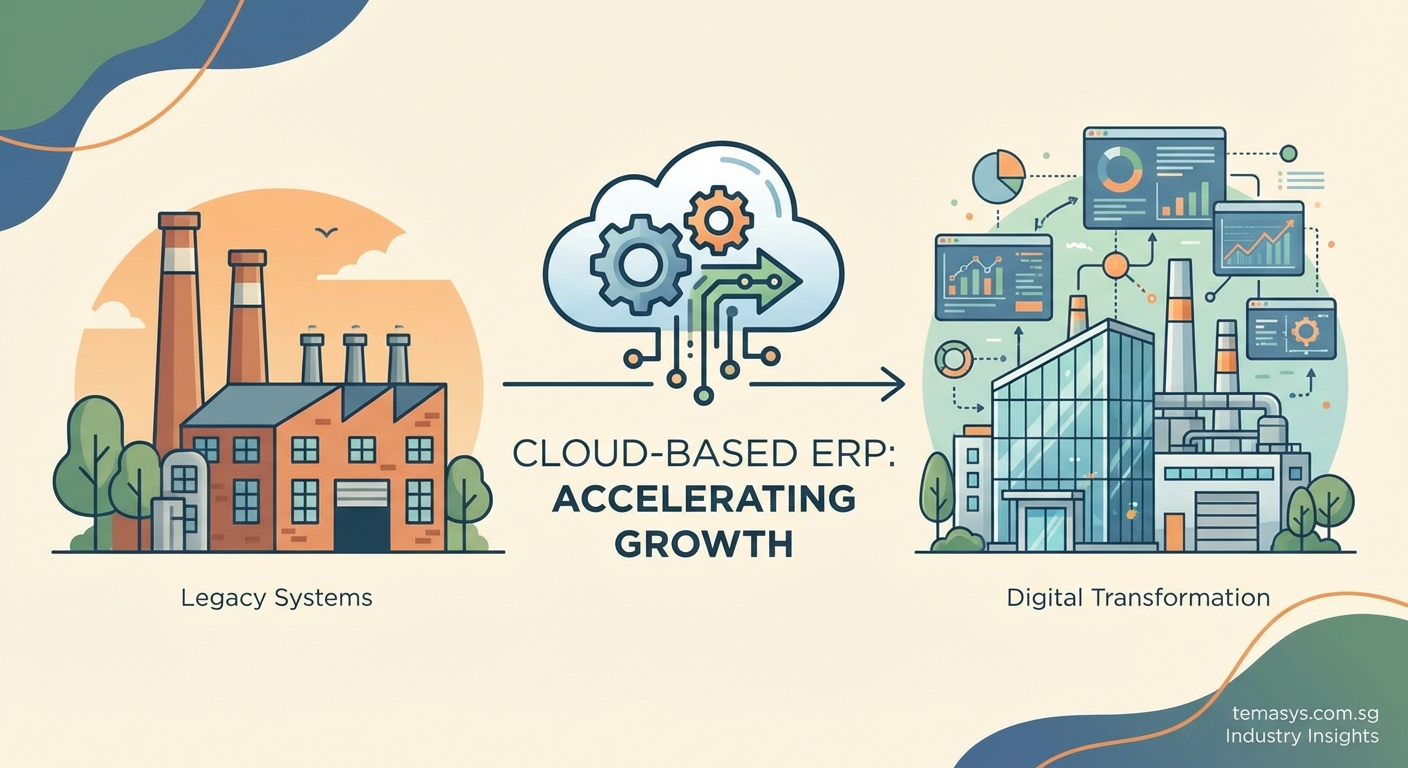
The total cost picture has shifted dramatically in the past three years.
Traditional ERP implementations required substantial upfront investment:
- Server hardware and storage infrastructure
- Dedicated IT staff for system maintenance
- Cooling and power for on-premise data centres
- Disaster recovery and backup systems
- Regular hardware refresh cycles every 3 to 5 years
Cloud ERP replaces these capital expenses with predictable monthly subscriptions. You pay for what you use. When production scales up, you add users. When seasonal demand drops, you scale back.
A mid-sized electronics manufacturer in Penang recently shared their numbers. Their on-premise system cost SGD 850,000 upfront, plus SGD 180,000 annually for maintenance, support, and infrastructure. After switching to cloud ERP, their monthly subscription runs SGD 12,000, with no hardware costs and automatic updates included.
The math gets more compelling when you factor in implementation time. Traditional deployments often take 12 to 18 months. Cloud implementations typically complete in 4 to 6 months because there’s no infrastructure to build.
Understanding how much ERP implementation really costs helps you build accurate budget projections and avoid hidden expenses.
Regional infrastructure improvements enabling cloud adoption
Southeast Asia’s digital infrastructure has matured significantly.
Internet connectivity across the region has improved to the point where cloud applications perform as well as on-premise systems. Major cloud providers now operate data centres in Singapore, Jakarta, and Bangkok, reducing latency and addressing data residency requirements.
Government initiatives support this shift. Singapore’s Smart Nation programme offers grants for digital transformation. Thailand’s Digital Economy Promotion Agency provides funding for manufacturers adopting cloud technologies. Indonesia’s Ministry of Industry runs programmes specifically targeting manufacturing digitalisation.
These aren’t small incentives. Some programmes cover up to 50% of implementation costs for qualifying companies.
The regulatory environment has also evolved. Data protection laws across ASEAN now provide clear frameworks for cloud data storage and cross-border data transfers. This clarity removes a major barrier that previously kept manufacturers tied to on-premise systems.
How cloud ERP solves specific Southeast Asian manufacturing challenges
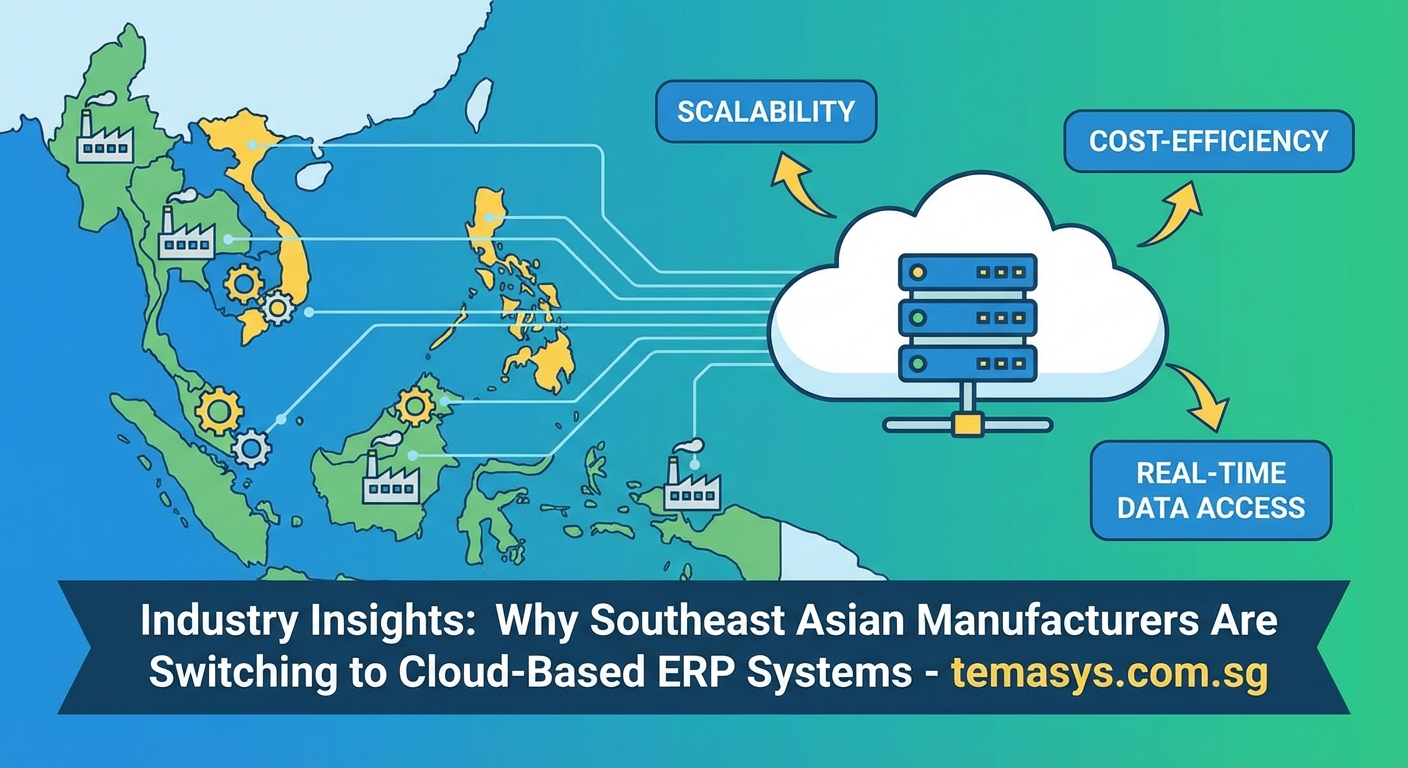
Let’s look at practical scenarios where cloud systems deliver measurable advantages.
Multi-site inventory management
A furniture manufacturer operates facilities in Malaysia, Vietnam, and the Philippines. Raw timber gets processed in Malaysia, components are assembled in Vietnam, and final products ship from the Philippines.
Their old ERP required manual inventory transfers between systems. Stock counts were always out of sync. Production planners in one country couldn’t see available materials in another location.
Cloud ERP gives everyone real-time visibility. When the Vietnam assembly line needs more components, the system shows exactly what’s available across all three sites. Automatic reorder triggers prevent stockouts. The finance team sees inventory values updated instantly across all locations.
Compliance across multiple jurisdictions
Tax regulations differ significantly across Southeast Asia. VAT rates, withholding tax requirements, and financial reporting standards vary by country.
Cloud ERP systems built for the region include localisation for each market. The system automatically applies the correct tax treatment based on transaction location. Financial reports generate in formats required by local authorities.
This becomes particularly valuable during audits. Instead of reconstructing transactions from multiple systems and spreadsheets, auditors can access a single source of truth with complete audit trails.
Rapid scaling for growing manufacturers
When a textile manufacturer wins a major contract requiring 40% more production capacity, traditional ERP creates bottlenecks. Adding server capacity takes weeks. Deploying new user licenses requires vendor negotiations. Training staff on system changes disrupts operations.
Cloud ERP scales immediately. New users get activated in minutes. The system handles increased transaction volumes without infrastructure changes. Training happens faster because the interface remains consistent.
Steps to evaluate cloud ERP for your manufacturing operation
Making this decision requires a structured approach. Here’s how successful manufacturers assess their options:
-
Document your current pain points with specific examples. Don’t just say “reporting is slow.” Quantify it. “Month-end close takes 12 days because we manually consolidate data from 4 different systems.”
-
Map your must-have requirements by business function. Production planning needs different capabilities than financial management. Get input from department heads, not just IT.
-
Identify your integration requirements early. What other systems need to connect with your ERP? Customer portals, supplier networks, logistics platforms, and quality management systems all need consideration.
-
Calculate your total cost of ownership over 5 years. Include hidden costs like staff training, system customisation, and the opportunity cost of slow deployment.
-
Test with real data during vendor evaluations. Demonstrations using generic sample data don’t reveal how the system handles your specific workflows. Insist on pilots using your actual business scenarios.
Following a complete pre-implementation checklist prevents costly mistakes and ensures you’ve covered all critical requirements.
Common deployment models for cloud ERP in Southeast Asia
Not all cloud deployments look the same. Understanding your options helps you choose the right approach.
| Deployment Model | Best For | Key Advantages | Considerations |
|---|---|---|---|
| Public cloud | Standard manufacturing processes | Fastest deployment, lowest cost, automatic updates | Less customisation flexibility |
| Private cloud | Highly regulated industries | Greater control, custom security policies | Higher cost than public cloud |
| Hybrid cloud | Companies with legacy systems | Gradual migration path, keeps critical systems on-premise temporarily | More complex to manage |
| Multi-tenant SaaS | Growing mid-sized manufacturers | Predictable costs, minimal IT overhead, proven scalability | Shared infrastructure with other tenants |
Most Southeast Asian manufacturers choose multi-tenant SaaS because it balances cost, functionality, and deployment speed.
The decision between models depends on your specific situation. A pharmaceutical manufacturer with strict regulatory requirements might need private cloud. A consumer goods company with standard processes typically does fine with public cloud.
Vendor selection criteria specific to Southeast Asian markets
Choosing the right ERP vendor matters as much as choosing the right deployment model.
Look for these capabilities when evaluating vendors:
- Regional data centre presence. Systems hosted in Singapore or Bangkok perform better than those routing through Sydney or Mumbai.
- Local support teams. When production stops at 2 AM, you need support staff who understand your time zone and business context.
- Multi-currency and multi-language support. Your system should handle Thai baht, Vietnamese dong, and Philippine pesos without currency conversion workarounds.
- Proven implementations in your industry. A vendor with 50 manufacturing clients in Southeast Asia brings valuable knowledge about regional challenges.
- Clear data residency policies. Some countries require certain data types to remain within national borders.
Watch for red flags when evaluating enterprise software vendors that signal potential problems down the road.
The biggest mistake we made was choosing a vendor based solely on features. We should have weighted implementation experience and local support much higher. The system had everything we needed on paper, but the vendor had never deployed in Southeast Asia before. We spent 6 months solving problems they should have anticipated.
That quote comes from an operations director at a Malaysian automotive parts manufacturer. Learn from their experience.
Integration requirements for modern manufacturing operations
Your ERP doesn’t operate in isolation. It needs to connect with other systems across your operation.
Critical integration points for manufacturers:
- Production equipment and IoT sensors for real-time monitoring
- Quality management systems for defect tracking and corrective actions
- Warehouse management systems for inventory accuracy
- Customer portals for order status and delivery tracking
- Supplier networks for procurement and vendor management
- Logistics platforms for shipment tracking and freight management
- Business intelligence tools for advanced analytics
Cloud ERP systems typically offer better integration options than legacy platforms. Modern APIs make connections simpler and more reliable.
Before committing to a vendor, verify they support the integrations you need. Ask for specific examples from other customers. Request technical documentation showing how the connections work.
The ERP integration guide provides detailed frameworks for planning and executing system connections.
Change management strategies that work in Southeast Asian manufacturing
Technology is only half the challenge. Getting your team to adopt new systems requires deliberate change management.
Cultural factors matter in Southeast Asia. Hierarchical organisations need different approaches than flat structures. Older workers who’ve used the same systems for 20 years need more support than younger staff.
Successful implementations share these characteristics:
- Executive sponsorship from the top. When the managing director actively supports the change, middle management follows.
- Department champions who advocate for the new system. Identify respected team members in each function to lead adoption.
- Training in local languages. Don’t assume everyone is comfortable with English-only training materials.
- Gradual rollout by location or function. Trying to switch everything at once creates chaos.
- Clear communication about why the change matters. Connect system benefits to individual job responsibilities.
A food processing company in Thailand took 8 months to fully deploy their cloud ERP. They started with a single production line, refined their approach based on feedback, then expanded to other facilities. This gradual method prevented the disruptions that often derail implementations.
Learning from companies that have overcome resistance during system changes gives you proven tactics for managing your own transition.
Security and compliance considerations for cloud ERP
Moving business-critical systems to the cloud raises legitimate security questions.
Modern cloud ERP platforms typically offer better security than most companies can achieve on-premise. Major vendors invest millions in security infrastructure, employ dedicated security teams, and maintain certifications that would be prohibitively expensive for individual manufacturers.
Key security features to verify:
- Data encryption in transit and at rest
- Multi-factor authentication for user access
- Role-based permissions that limit data access by function
- Automated backup and disaster recovery
- Regular security audits and penetration testing
- Compliance certifications relevant to your industry
Different Southeast Asian countries have different data protection requirements. Singapore’s Personal Data Protection Act, Thailand’s Personal Data Protection Act, and Indonesia’s Electronic Information and Transactions Law all impose specific obligations on how you handle data.
Choose vendors who understand these requirements and can demonstrate compliance. Ask for documentation showing how their systems meet local regulations.
Performance benchmarks from recent cloud ERP implementations
Real results from recent implementations provide useful benchmarks for your own expectations.
A precision engineering company in Singapore reported these improvements six months after going live with cloud ERP:
- Order processing time reduced from 45 minutes to 8 minutes
- Month-end financial close shortened from 15 days to 4 days
- Inventory accuracy improved from 87% to 98%
- On-time delivery performance increased from 72% to 91%
- IT infrastructure costs decreased by 62%
An electronics manufacturer in Penang saw different but equally significant benefits:
- Real-time visibility across 3 production facilities
- 34% reduction in excess inventory
- Supplier lead time tracking that identified bottlenecks
- Automated compliance reporting saving 120 hours monthly
- Mobile access enabling faster management decisions
These aren’t exceptional cases. They represent typical outcomes when implementations are planned properly and executed well.
Setting realistic expectations based on industry-specific benchmarks helps you measure success and identify areas needing attention.
Timeline expectations for cloud ERP deployment
Understanding realistic timelines prevents frustration and helps you plan resources effectively.
Typical cloud ERP implementation phases:
| Phase | Duration | Key Activities |
|---|---|---|
| Planning and requirements | 4 to 6 weeks | Process documentation, vendor selection, project team formation |
| System configuration | 8 to 12 weeks | Setup, customisation, integration development, data migration planning |
| Testing and training | 6 to 8 weeks | User acceptance testing, staff training, pilot operations |
| Go-live and stabilisation | 2 to 4 weeks | Cutover, hypercare support, issue resolution |
| Optimisation | Ongoing | Process refinement, additional training, feature adoption |
Total timeline from decision to full operation typically runs 5 to 7 months for mid-sized manufacturers. Larger organisations with complex operations might need 8 to 10 months.
These timelines assume dedicated project resources and active management support. Part-time project teams working around daily responsibilities take significantly longer.
Building a realistic implementation timeline with appropriate buffers prevents the rushed decisions that lead to problems later.
Avoiding the mistakes that derail cloud ERP projects
Learning from others’ failures saves time, money, and frustration.
The most common mistakes manufacturers make:
- Underestimating data cleanup requirements. Migrating messy data creates messy systems. Budget time for data quality work before migration.
- Skipping process standardisation. If every location operates differently, you’ll either force standardisation during implementation or build expensive customisations.
- Treating implementation as an IT project. This is a business transformation that requires business leadership, not just technical expertise.
- Ignoring change management until go-live. By then it’s too late. Start communicating and training early.
- Choosing the wrong implementation partner. Vendor selection matters, but so does choosing the right systems integrator or consultant.
A packaging manufacturer in Indonesia learned this lesson the hard way. They selected a capable ERP platform but chose an implementation partner with no manufacturing experience. The project ran 9 months over schedule and required extensive rework.
Understanding critical mistakes companies make during software selection helps you avoid repeating them.
What successful cloud ERP adoption looks like in practice
Let’s look at a complete example showing how this works in reality.
A consumer electronics manufacturer operates facilities in Singapore, Malaysia, and Vietnam. They employed 380 people and generated SGD 120 million in annual revenue. Their legacy ERP was 15 years old, running on servers in their Singapore office.
Their pain points:
- Production planning required phone calls between sites to check inventory
- Financial consolidation took 2 weeks each month
- Customer service couldn’t see order status across locations
- IT spent 60% of their time maintaining aging infrastructure
- Adding new users required hardware upgrades
They evaluated four cloud ERP vendors over 3 months. After detailed requirements gathering and proof-of-concept testing, they selected a vendor with strong manufacturing functionality and proven Southeast Asian implementations.
Implementation took 6 months:
- Month 1 to 2: Requirements finalisation, data cleanup, team training
- Month 3 to 4: System configuration, integration development, testing
- Month 5: Pilot at Singapore facility, refinement based on feedback
- Month 6: Rollout to Malaysia and Vietnam locations
Results after 12 months:
- Real-time inventory visibility across all sites
- Month-end close reduced to 4 days
- Customer service response time improved by 65%
- IT team refocused on strategic projects instead of maintenance
- System scaled to support 40% revenue growth without additional infrastructure
The total implementation cost was SGD 420,000, including software, consulting, training, and data migration. Their previous system cost SGD 180,000 annually just for maintenance. The cloud subscription runs SGD 15,000 monthly, including all updates and support.
Making cloud ERP work for your manufacturing operation
The shift to cloud ERP in Southeast Asia reflects fundamental changes in how manufacturers need to operate.
Traditional systems were built for stable, predictable environments. Today’s manufacturing reality involves volatile supply chains, rapid market changes, and operations spanning multiple countries with different regulations.
Cloud platforms address these challenges by providing real-time visibility, faster deployment, lower total cost, and better scalability than on-premise alternatives.
The question isn’t whether cloud ERP makes sense for Southeast Asian manufacturers. The data clearly shows it does for most operations. The real question is when to make the move and how to execute it properly.
Start by honestly assessing your current system’s limitations. Quantify the business impact of those limitations. Then evaluate whether cloud ERP addresses your specific pain points better than maintaining your existing platform.
If you decide to move forward, invest time in proper planning. The manufacturers who get the best results are those who treat implementation as a business transformation project, not just a technology upgrade. They involve operational leaders from the start, dedicate appropriate resources, and manage change deliberately.
The regional infrastructure, vendor capabilities, and cost models have all reached the point where cloud ERP is now the practical choice for most Southeast Asian manufacturers. The companies making this transition now are positioning themselves for competitive advantages that will compound over the next decade.