
Choosing the wrong enterprise software vendor can cost your organisation years of frustration, millions in sunk costs, and countless hours of lost productivity. Yet many Singapore businesses rush through vendor selection, only to discover major problems after contracts are signed and implementation begins.
The stakes are high. A poor vendor choice affects not just your IT department but every team that depends on the system. Finance struggles with incomplete reports. Operations battles workarounds. Your staff wastes time on manual fixes that shouldn’t exist.
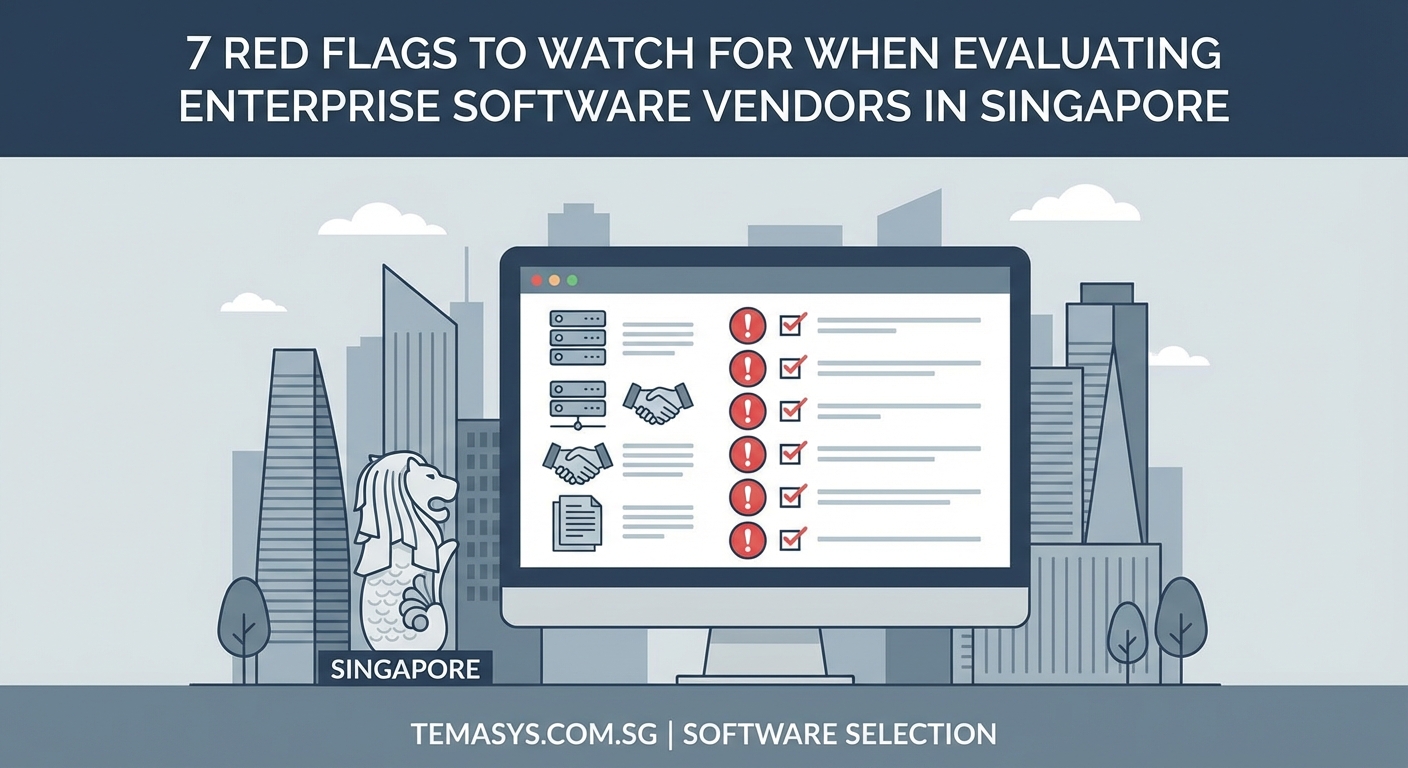
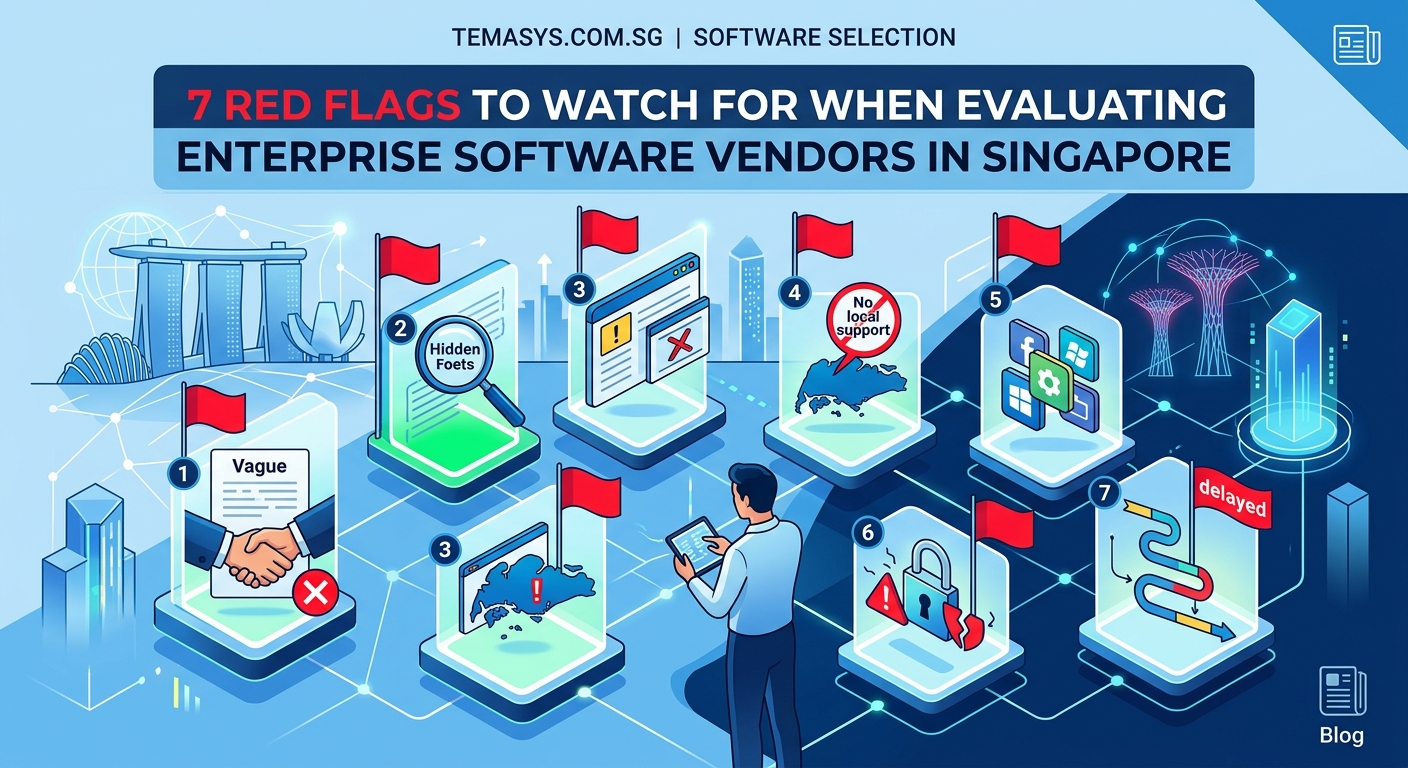
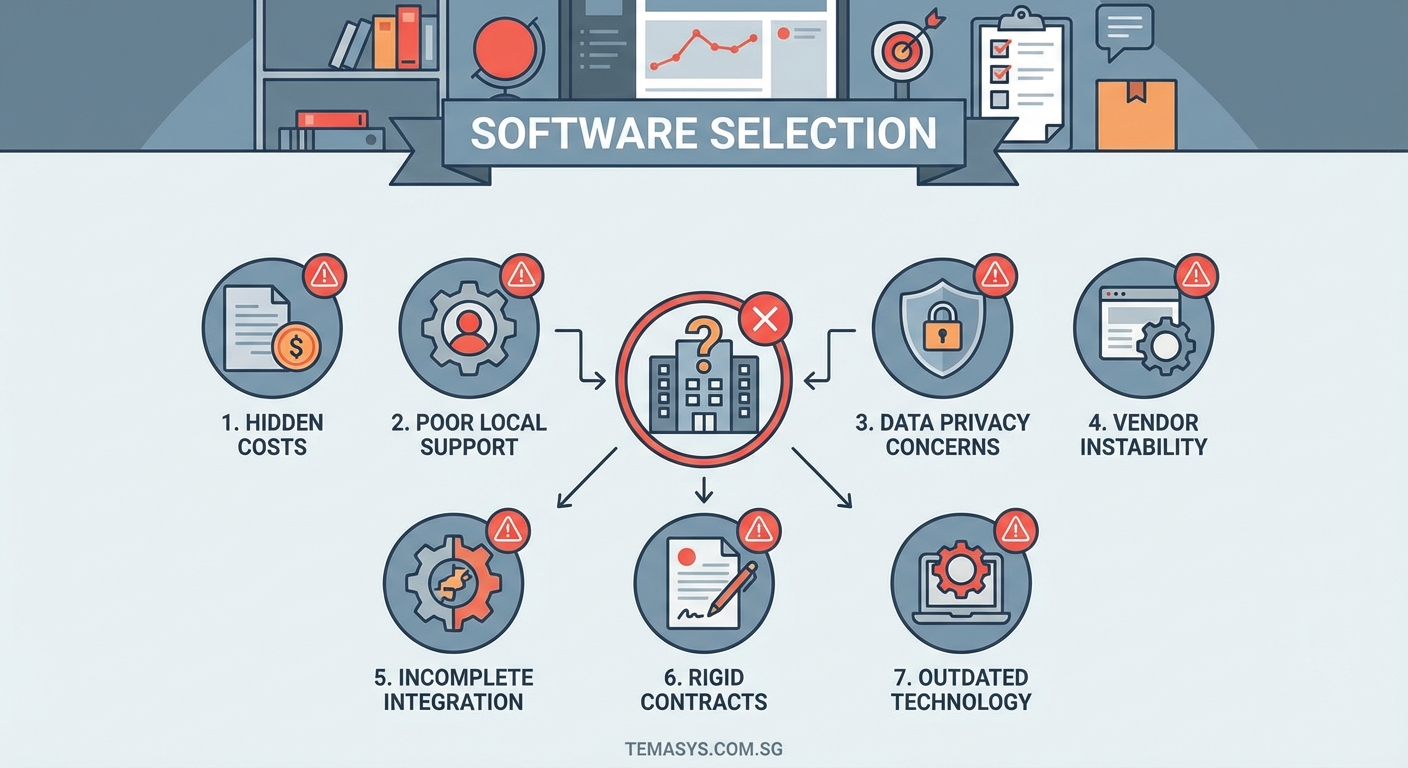
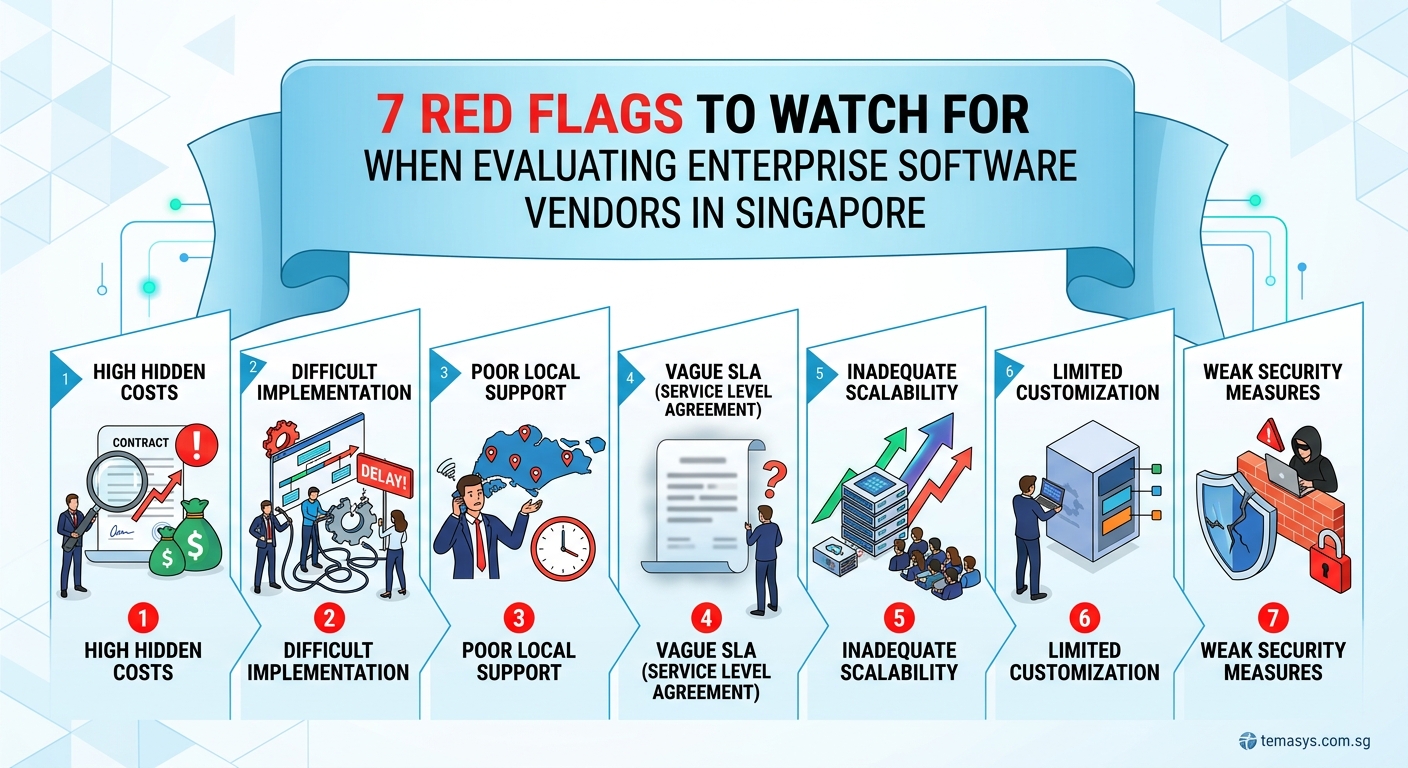
When evaluating enterprise software vendors, watch for seven critical warning signs: vague pricing structures, poor local support presence, limited integration capabilities, weak security credentials, unrealistic implementation timelines, missing client references, and inflexible contract terms. Spotting these red flags early prevents costly mistakes and protects your organisation from vendor relationships that drain resources without delivering promised value. Singapore enterprises need vendors who understand local compliance requirements and can scale with regional growth.
Why vendor selection matters more than features
Most organisations focus heavily on feature lists and demos. They spend weeks comparing functionality across different platforms.
But the software itself is only half the equation.
Your vendor relationship determines whether implementation succeeds or fails. It shapes how quickly your team adopts the new system. It affects your ability to customise, integrate, and scale.
A great product paired with a poor vendor creates problems that no amount of functionality can fix. Meanwhile, a solid vendor partnership can help you maximise value even from an imperfect platform.
The difference shows up in real costs. Implementation delays. Training expenses. Customisation fees. Support tickets that go unanswered. These hidden costs often exceed the initial licence price.
Singapore businesses face unique challenges when evaluating enterprise software vendors. Local compliance requirements. Multi-currency operations. Regional expansion plans. Your vendor needs to understand these contexts, not just sell you a global product.
Red flag 1: Pricing that makes no sense
Transparent pricing should be standard. Yet many vendors make it deliberately confusing.
Watch for these warning signs:
- Base prices that exclude essential features
- Per-user fees that balloon with team growth
- Hidden charges for basic support
- Vague language about “customisation costs”
- Refusal to provide written quotes
- Pressure to sign before seeing full pricing
One Singapore manufacturing firm discovered their “affordable” ERP system actually cost three times the quoted price once they added necessary modules, training, and support tiers.
Ask vendors to break down every cost component. Implementation fees. Annual maintenance. Training hours. Integration work. Customisation charges. Data migration expenses.
If they can’t or won’t provide clear numbers, that’s your first red flag.
“A vendor who hides pricing details is telling you they don’t trust their own value proposition. They’re hoping you’ll commit before doing the maths properly.”
Red flag 2: No real local presence
Many international vendors claim to “serve Singapore” but have no actual office, staff, or support infrastructure in the region.
This matters more than you might think.
Time zone differences turn simple support requests into day-long waits. Cultural misunderstandings create communication friction. Legal and compliance questions go unanswered because overseas teams don’t understand local requirements.
Check whether your vendor has:
- Physical office in Singapore or nearby
- Local implementation team
- Regional support staff (not just email routing)
- Understanding of PDPA and other Singapore regulations
- Experience with CPF, GST, and local tax systems
- References from other Singapore clients
One retail company chose a vendor with impressive global credentials but zero Singapore presence. Every support call went to a call centre in another continent. Implementation delays piled up because the overseas team didn’t understand local business practices.
Understanding local requirements becomes critical during implementation. Your vendor should know Singapore’s business landscape, not just claim they can “adapt” to it.
Red flag 3: Integration promises without proof
Modern enterprises run on connected systems. Your new software needs to talk to existing platforms.
Yet many vendors promise “seamless integration” without demonstrating actual capability.
Ask specific questions:
- Which systems have you integrated with before?
- Can you show us working examples?
- What APIs or connectors do you provide?
- Who handles integration work and at what cost?
- How long do typical integrations take?
- What happens when our other systems update?
Vague answers or deflection here signal trouble ahead.
| Integration Approach | What It Means | Risk Level |
|---|---|---|
| Pre-built connectors | Ready-made links to popular platforms | Low |
| Open API with documentation | You can build connections yourself | Medium |
| “We can integrate anything” | Probably requires expensive custom work | High |
| “You’ll need middleware” | Extra cost and complexity | High |
| No clear answer | They haven’t done it before | Very High |
One logistics firm spent six months and $200,000 trying to connect their new system to existing warehouse management software. The vendor had promised integration would be “straightforward” but had never actually done it before.
System integration complexity often determines whether your investment succeeds or becomes an expensive isolated island.
Red flag 4: Security credentials that don’t check out
Enterprise software handles your most sensitive business data. Customer information. Financial records. Operational secrets.
Your vendor’s security posture directly affects your risk exposure.
Yet many organisations skip thorough security vetting. They assume certifications mean protection. They trust vendor assurances without verification.
Dig deeper:
- Request recent security audit reports
- Verify ISO 27001 or SOC 2 certifications
- Ask about data residency and sovereignty
- Check their incident response history
- Understand backup and disaster recovery procedures
- Review their access control policies
Singapore’s PDPA requirements make vendor security even more critical. You remain liable for data breaches even when a vendor’s security fails.
One professional services firm faced regulatory scrutiny after their vendor suffered a data breach. The vendor had claimed “bank-level security” but hadn’t updated systems in years. The firm faced fines and reputational damage despite not directly causing the breach.
Red flag 5: Timelines that defy reality
Unrealistic implementation promises should trigger immediate scepticism.
Complex enterprise systems take time to implement properly. Data migration. Process mapping. Customisation. Testing. Training. Change management.
Vendors who promise impossibly fast timelines either don’t understand the work involved or plan to cut corners that will hurt you later.
Watch for these timeline red flags:
- Implementation schedules shorter than similar projects
- No buffer for testing or training
- Rushed data migration plans
- Skipped change management phases
- Pressure to “go live” before you’re ready
A distribution company accepted a vendor’s promise of eight-week implementation. Six months later, they were still fixing data problems and retraining confused staff. The rushed timeline had created chaos that took years to fully resolve.
Build realistic expectations by talking to other clients. Ask how long their implementations actually took, not how long the vendor promised.
Setting proper timelines protects your team from burnout and your business from operational disruption.
Red flag 6: References they won’t provide
Legitimate vendors proudly share client success stories. They connect you with references. They showcase implementations similar to yours.
Vendors who avoid references usually have reasons.
Unhappy clients. Failed implementations. Ongoing disputes. High churn rates.
During evaluation, request:
- Contact details for three similar clients
- Case studies from your industry
- References from Singapore or regional implementations
- Permission to visit a live installation
- Access to user community forums
One financial services firm later discovered their vendor had only two other clients in Southeast Asia, both struggling with the same problems. The vendor had carefully avoided providing references that might reveal this pattern.
Don’t accept excuses about confidentiality. Professional references are standard practice. Clients who are genuinely happy usually agree to share experiences.
Check online reviews and forums too. Look for patterns in complaints. Single negative reviews happen. Repeated issues across multiple sources signal systemic problems.
Red flag 7: Contracts designed to trap you
Contract terms reveal how vendors view the relationship.
Fair agreements protect both parties. Predatory contracts lock you in while limiting vendor accountability.
Review these contract elements carefully:
- Exit clauses and data portability rights
- Liability limitations and indemnification
- Price increase mechanisms
- Support level guarantees
- Customisation ownership
- Renewal and termination terms
Many Singapore businesses discover too late that their contract makes switching vendors prohibitively expensive. Data export fees. Format restrictions. Extended notice periods. Penalty clauses.
One manufacturing company found themselves paying for a system they’d stopped using because the three-year contract included automatic renewal with six-month advance notice. They missed the deadline by two weeks and got locked in for another full term.
Have legal counsel review contracts before signing. The cost of proper review is minimal compared to the cost of a bad agreement.
Consider negotiating:
- Shorter initial terms with renewal options
- Clear data ownership and export rights
- Performance guarantees with remedies
- Reasonable price escalation caps
- Flexibility for changing business needs
Building your evaluation framework
Systematic vendor evaluation protects you from emotional decisions and sales pressure.
Create a structured process:
- Define your requirements clearly before talking to vendors
- Score each vendor against consistent criteria
- Involve multiple stakeholders from different departments
- Test with proof of concept projects when possible
- Check references thoroughly and independently
- Review all costs in writing before deciding
- Negotiate contracts with legal guidance
Weight different factors based on your priorities. Some organisations prioritise support quality. Others focus on integration capability. Many Singapore businesses need strong local compliance understanding.
Document everything. Sales promises. Demo capabilities. Timeline commitments. Pricing details.
Memories fade. Sales representatives move on. Written records protect you when reality doesn’t match promises.
Avoiding common mistakes during vendor selection prevents problems that derail entire digital transformation initiatives.
Questions that reveal vendor quality
The questions you ask matter as much as the answers you receive.
Surface-level questions get rehearsed responses. Deeper questions reveal actual capability and commitment.
Ask about failures and challenges:
- “Tell me about an implementation that went wrong and how you handled it.”
- “What’s the most common reason clients struggle with your system?”
- “When do you recommend clients NOT choose your solution?”
Honest vendors acknowledge limitations. They discuss lessons learned. They help you understand where their solution fits and where it doesn’t.
Evasive vendors deflect. They blame clients for problems. They claim their product suits everyone.
Ask about your specific situation:
- “How have other clients in our industry used this system?”
- “What customisations would we likely need?”
- “How will this integrate with our existing platforms?”
- “What’s involved in migrating our current data?”
Generic answers suggest limited relevant experience. Specific, detailed responses demonstrate real understanding.
The cost of getting it wrong
Bad vendor choices create costs that compound over time.
Direct financial costs are just the beginning. Wasted licence fees. Failed implementation expenses. Consultant fees trying to fix problems.
Operational costs hurt more. Staff working around system limitations. Manual processes that should be automated. Reports that don’t provide needed insights.
Opportunity costs are hardest to measure but most damaging. Projects delayed. Growth constrained. Competitive advantages lost.
One Singapore retail chain spent three years and over $2 million on an ERP system that never worked properly. They eventually abandoned it and started over with a different vendor. The total cost including lost opportunities exceeded $5 million.
Understanding true implementation costs helps you evaluate vendor proposals realistically and spot lowball bids that will balloon later.
Making the final decision
No vendor is perfect. Every option involves tradeoffs.
Your goal isn’t finding a flawless vendor. It’s choosing one whose strengths match your priorities and whose weaknesses you can manage.
Weight factors based on what matters most to your organisation:
- Growing rapidly? Prioritise scalability and flexibility
- Highly regulated industry? Focus on compliance and security
- Complex operations? Need strong customisation capability
- Limited IT resources? Require excellent support and training
- Multi-country operations? Must have regional experience
Create a scorecard that reflects your priorities. Rate each vendor objectively. Include input from different stakeholders who will live with the decision.
Don’t let a single factor override everything else. The cheapest option often costs most in the long run. The most feature-rich platform may be impossible to implement. The vendor with the best sales pitch might deliver poor support.
Trust your evaluation process. If red flags appear, take them seriously. Sales pressure to “sign now” or “lock in this price” should make you more cautious, not less.
Smart vendor selection protects your investment
Choosing enterprise software vendors carefully sets the foundation for digital transformation success.
The hours you invest in thorough evaluation pay dividends for years. You avoid expensive mistakes. You build partnerships that support growth. You implement systems that actually improve operations.
Singapore businesses that rush vendor selection often spend years recovering from poor choices. Those who evaluate systematically create competitive advantages that compound over time.
Watch for the seven red flags. Ask hard questions. Check references thoroughly. Review contracts carefully. Trust your instincts when something feels wrong.
Your organisation deserves a vendor partner who understands your needs, delivers on promises, and supports your success. Settling for less costs too much.