
Running a business in Singapore means juggling tight margins, rising labour costs, and constant pressure to do more with less. You’ve probably heard about robotic process automation (RPA) and wondered if it’s just another buzzword or something that actually works for companies your size. Here’s the truth: Singapore SMEs are already using RPA to cut operational costs by 30 to 40%, and the technology is more accessible than you think.
RPA for SMEs Singapore delivers measurable cost savings by automating repetitive tasks like invoice processing, data entry, and customer service. Local businesses report 30 to 40% reductions in operational expenses, faster processing times, and fewer errors. Implementation takes weeks, not months, and doesn’t require massive IT infrastructure. This guide shows you exactly how to evaluate, deploy, and measure RPA success in your organisation.
What makes RPA different from traditional automation
Traditional automation requires custom coding and deep integration with your existing systems. That means months of development, expensive consultants, and rigid workflows that break when anything changes.
RPA works differently.
Software robots mimic human actions. They log into applications, copy and paste data, fill forms, and process transactions just like your staff does. No need to rip out your current systems or build complex APIs.
A logistics SME in Jurong recently automated their delivery scheduling process. The robot logs into three separate systems, checks inventory, matches customer orders, and generates delivery schedules. What used to take two staff members four hours now runs in 20 minutes while they sleep.
The beauty of RPA lies in its flexibility. When your process changes, you update the robot’s instructions. When you add a new system, you teach the robot where to click. No developer required for simple modifications.
Real cost savings Singapore SMEs are seeing
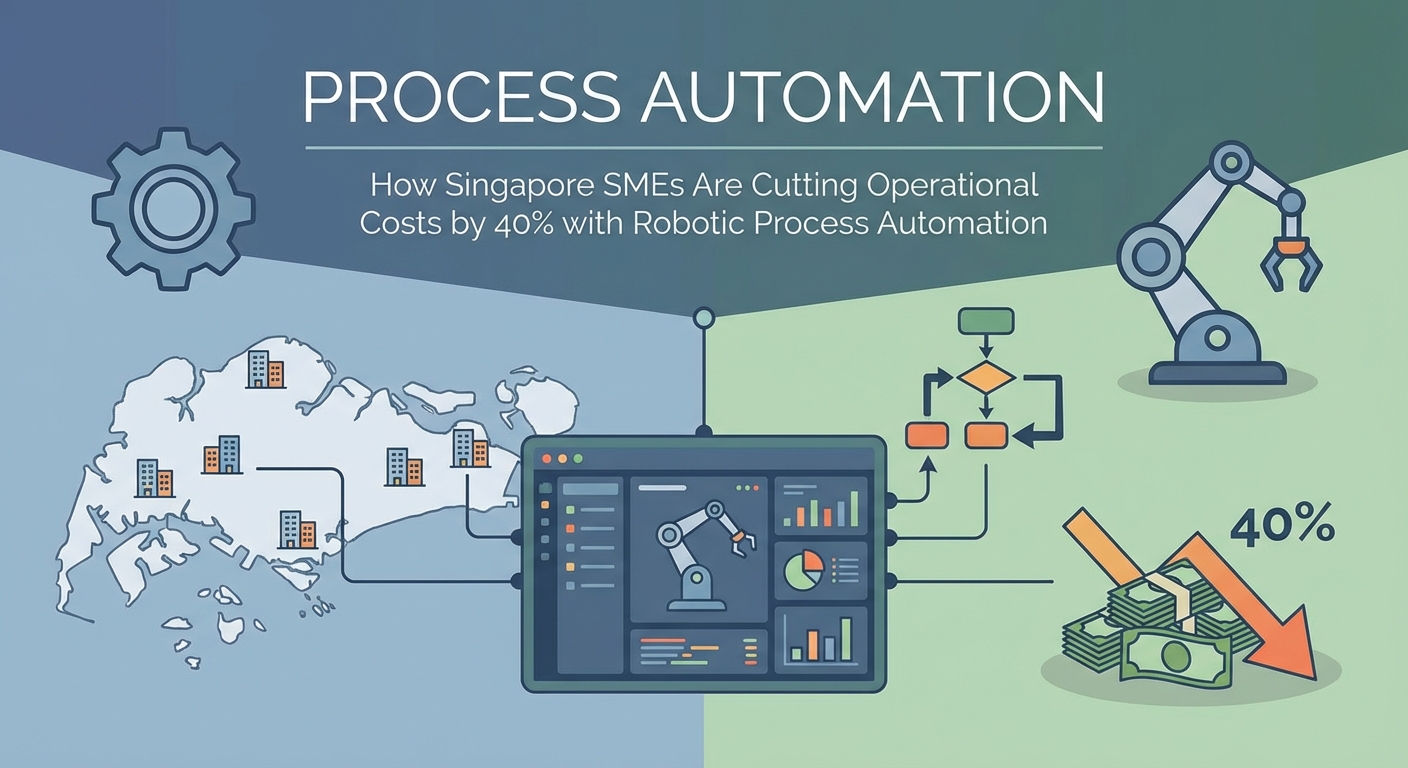
Let’s talk numbers. A typical accounts payable clerk in Singapore costs between $2,800 and $3,500 monthly. Add CPF contributions, leave coverage, training, and workspace, and you’re looking at $50,000 to $60,000 annually per person.
An RPA bot handling the same invoice processing tasks costs roughly $8,000 to $15,000 for the first year, including implementation and licensing. Year two onwards drops to $3,000 to $6,000 annually.
Here’s what local SMEs report:
- A trading company reduced invoice processing time from 3 days to 4 hours
- A healthcare clinic cut appointment confirmation calls by 85%
- A manufacturing firm eliminated 200 hours monthly of manual data entry
- A retail chain reduced inventory reconciliation from weekly to daily with zero additional headcount
The savings compound over time. Fewer errors mean less rework. Faster processing means better cash flow. 24/7 operation means no overtime costs during peak periods.
One F&B distributor shared that their month-end closing used to require three temporary staff for a week. After implementing RPA for financial reconciliation, the process runs overnight with one person reviewing the results the next morning.
How to identify which processes to automate first
Not every task makes sense for RPA. You want high-volume, rule-based processes that don’t require human judgment.
Start by listing tasks your team does repeatedly. Then score each one:
- Volume: How many times per day, week, or month does this happen?
- Rule clarity: Can you write down exact steps someone would follow?
- System stability: Do the applications involved change frequently?
- Error cost: What happens when mistakes occur?
- Staff satisfaction: Do people enjoy this task or find it tedious?
High scores on volume, rule clarity, and low staff satisfaction make excellent RPA candidates. Low scores on system stability might mean you should wait.
| Process Type | RPA Suitability | Typical ROI Timeline |
|---|---|---|
| Invoice processing | Excellent | 3 to 6 months |
| Data entry between systems | Excellent | 2 to 4 months |
| Report generation | Very good | 4 to 8 months |
| Customer onboarding | Good | 6 to 12 months |
| Complex decision-making | Poor | Not recommended |
| Creative work | Poor | Not recommended |
A manufacturing SME made the mistake of trying to automate their quality control decisions first. The process involved too many judgment calls and visual inspections. After three months of frustration, they switched to automating purchase order creation. That succeeded in two weeks.
“We wasted time trying to automate the interesting problems. The real wins came from automating the boring stuff nobody wanted to do anyway. Our team was happy to hand over repetitive data entry, and we saw results immediately.” – Operations Director, Singapore logistics firm
The practical steps to implement RPA in your business
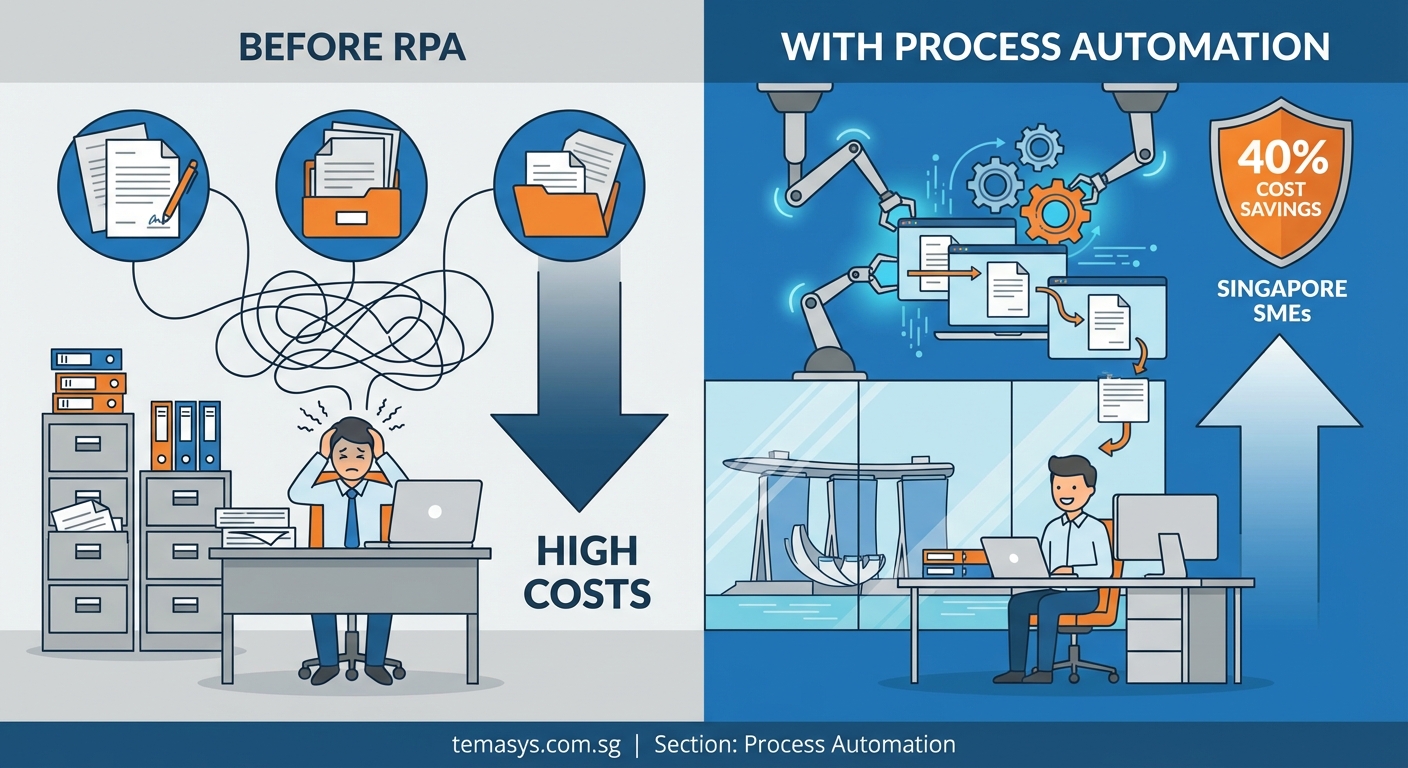
Implementation doesn’t need to be complicated. Most Singapore SMEs get their first bot running within 4 to 8 weeks.
-
Document your current process exactly as it happens today. Record every click, every field, every decision point. Use screenshots. Write down the steps a new employee would follow. Include the exceptions and edge cases.
-
Choose your RPA platform based on your technical capability. Cloud-based options like UiPath, Automation Anywhere, and Blue Prism offer SME-friendly pricing. Some require IT expertise. Others let business users build bots with visual designers. Match the tool to your team’s skills.
-
Start with a pilot project that matters but won’t break the business if it fails. Pick something with clear before-and-after metrics. Track time saved, errors reduced, and costs avoided. Use this data to build your case for scaling up.
-
Train a small internal team to maintain and expand your RPA capability. Send one or two people for vendor training. They become your automation champions. This approach costs less than hiring consultants for every change and builds valuable internal capability.
-
Measure everything and communicate wins to your organisation. Create a simple dashboard showing hours saved, transactions processed, and error rates. Share these numbers monthly. When people see results, adoption accelerates.
The biggest mistake Singapore SMEs make is trying to automate everything at once. A retail company attempted to deploy 12 bots simultaneously. Half failed. Staff got frustrated. The project stalled for six months. When they restarted with one bot, refined it, then added the next, they had 8 running smoothly within a year.
Common pitfalls and how to avoid them
Many SMEs underestimate the importance of process stability. If your underlying process changes every few weeks, your bot will break constantly. Fix the process first, then automate it.
Others forget about exception handling. Robots follow instructions precisely. When something unexpected happens, they need clear rules about what to do. Should they stop? Alert someone? Skip the transaction? Define these scenarios upfront.
- Pitfall: Automating a broken process makes it fail faster
- Solution: Map and optimise the workflow before building the bot
- Pitfall: No governance leads to bot sprawl and maintenance nightmares
- Solution: Create a simple approval process for new automation projects
- Pitfall: Forgetting to plan for system updates and changes
- Solution: Schedule quarterly bot health checks and update sessions
- Pitfall: Poor communication creates fear among staff about job security
- Solution: Position RPA as eliminating tedious work, not eliminating people
A professional services firm deployed RPA without telling their team why. Rumours spread about layoffs. Productivity dropped as people worried about their jobs. When leadership finally explained that automation would free staff for client-facing work and nobody would lose their job, morale recovered. But trust took months to rebuild.
Integrating RPA with your existing enterprise systems
RPA works alongside your current software. It doesn’t replace your ERP, CRM, or accounting system. It connects them.
Think of robots as digital workers who can access multiple systems simultaneously. Your ERP holds inventory data. Your e-commerce platform receives orders. Your accounting software needs invoice details. Instead of having someone manually copy information between these systems, a bot does it in seconds.
This integration approach means you can implement RPA without the massive investment and disruption of replacing your core systems. Many Singapore SMEs considering ERP implementation costs find that RPA delivers faster ROI by maximising value from existing software.
The key is understanding which integration method fits each scenario. Surface-level automation uses the application interface, just like a person would. API-based integration requires technical setup but runs faster and more reliably. Database-level integration offers the most control but needs careful security management.
For most SME use cases, surface-level automation works perfectly. A trading company automated their supplier payment approval workflow by having the bot read emails, extract invoice details, check them against purchase orders in their ERP, and route approvals through their workflow system. All without a single API integration.
Building internal capability versus outsourcing
You face a choice: build RPA expertise internally or hire consultants to do it for you.
Consultants get you started faster. They bring experience from other implementations. They handle the technical complexity. But they’re expensive, and you become dependent on them for every change.
Building internal capability takes longer initially. Your team needs training. The first few bots take more time to build. But you gain flexibility, lower ongoing costs, and deep knowledge of how automation works in your specific context.
Most successful Singapore SMEs use a hybrid approach. Hire a consultant for the first project. Have them work alongside your team. Transfer knowledge deliberately. By project two, your team leads with consultant support. By project three, you’re independent.
A wholesale distributor spent $35,000 on their first RPA implementation with full consultant support. They spent $12,000 on the second project with limited consulting. The third project cost $4,000 in licensing and was completed entirely by their operations coordinator who had been through vendor training.
The decision often connects to your broader technology strategy. Companies pursuing digital transformation typically invest in building internal automation skills as part of developing overall digital capability.
Measuring ROI and proving value to stakeholders
Your CFO wants numbers. Your operations team wants efficiency. Your staff wants less tedious work. RPA can deliver all three, but you need to measure it properly.
Track these metrics from day one:
- Time savings: Hours per week the bot runs versus manual processing time
- Cost avoidance: Salary cost of equivalent headcount needed without automation
- Error reduction: Mistakes before and after automation
- Processing speed: Transaction throughput improvement
- Staff satisfaction: How team members feel about handing off repetitive tasks
Calculate your payback period simply. Take your total implementation cost and divide it by monthly savings. A $15,000 implementation saving $2,500 monthly pays back in six months.
But ROI isn’t just about direct cost savings. Factor in opportunity cost. What can your team accomplish with the time RPA frees up? A customer service team that automated ticket categorisation redirected those hours to handling complex customer issues. Customer satisfaction scores increased by 18%. That’s harder to quantify but equally valuable.
One manufacturing SME created a simple dashboard showing their RPA program metrics. Total hours saved: 2,400 annually. Equivalent headcount avoided: 1.2 full-time positions. Error rate reduction: 94%. Payback period: 4.8 months. They updated these numbers quarterly and shared them in town halls. When budget season arrived, expanding the RPA program was an easy approval.
Addressing security and compliance concerns
Robots access your systems with credentials. They process sensitive data. They execute financial transactions. Security matters.
Set up bot credentials separately from human accounts. Use service accounts with appropriate permissions. Enable detailed logging of every action the bot takes. Review these logs regularly.
For compliance-heavy industries like healthcare or financial services, RPA can actually improve audit trails. Every transaction gets logged with timestamps. No manual process offers that level of documentation.
A medical clinic worried about patient data privacy when considering RPA for appointment scheduling. They worked with their vendor to ensure bots accessed only necessary fields, all actions were logged, and data never left Singapore servers. The implementation actually strengthened their compliance posture because they could prove exactly who accessed what information and when.
Consider these security practices:
- Store bot credentials in secure vaults, never in plain text
- Implement role-based access control for bot development and deployment
- Schedule regular security reviews of bot permissions
- Create an incident response plan for bot-related security events
- Ensure your RPA vendor complies with Singapore data protection regulations
Scaling from one bot to an automation program
Your first bot works. You’ve proven the concept. Now what?
Resist the urge to automate everything immediately. Successful RPA programs scale deliberately.
Create a pipeline of automation opportunities. Prioritise based on business impact and implementation complexity. Tackle a new process every quarter. Build momentum through consistent wins rather than attempting massive transformation overnight.
Establish governance early. Who can request a new bot? What’s the approval process? Who maintains existing bots? How do you handle changes to automated processes? Answer these questions before you have 20 bots running.
A distribution company started with one bot for order processing. After three months of stable operation, they added inventory reconciliation. Three months later, supplier payment processing. By year two, they had eight bots running smoothly with clear ownership, maintenance schedules, and change management processes.
The organisations that struggle with RPA scaling typically skip the governance step. Bots get built by different people using different standards. Nobody knows which bots exist or what they do. When something breaks, nobody knows how to fix it. A little structure prevents these headaches.
Connecting automation to broader business transformation
RPA rarely succeeds in isolation. It works best as part of a larger effort to modernise how you operate.
Think about your technology ecosystem. Are you running outdated systems that should be replaced? RPA might be a temporary bridge while you plan a proper upgrade. Are your processes poorly documented? Automating forces you to map and improve them.
Some Singapore SMEs use RPA as a stepping stone to more comprehensive change. They automate critical processes, prove the value of technology investment, then use that credibility to fund larger initiatives like ERP system upgrades or cloud migration.
Others find that RPA reveals gaps in their technology stack. A logistics company automated shipment tracking updates across multiple systems. The process worked but highlighted how disconnected their systems were. This insight led them to evaluate ERP integration options that would eliminate the need for that particular bot by connecting systems properly.
The key is viewing RPA as one tool in your operational improvement toolkit, not a complete solution. Use it where it makes sense. Combine it with process improvement, system upgrades, and capability building for maximum impact.
Getting started without overwhelming your team
You don’t need a massive budget or a dedicated IT department to begin with RPA.
Start small. Pick one annoying, repetitive task that everyone hates. Document how it works today. Research RPA platforms with free trials. Build a proof of concept yourself or with a small consultant engagement.
Many Singapore SMEs begin with attended automation, where robots work alongside people rather than running independently. An accounts clerk might trigger a bot to gather data from multiple systems, review the results, then approve the final action. This approach feels less risky and helps teams get comfortable with the technology.
Budget $10,000 to $20,000 for your first pilot, including software, training, and some consulting support. That’s enough to prove whether RPA works for your organisation without betting the farm.
Address the human side early. Talk to your team about why you’re doing this. Be honest about concerns. Nobody loses their job because of automation. They get to stop doing boring work and focus on things that actually require human judgment.
A retail company held workshops where staff identified their most tedious tasks. The team voted on which to automate first. When the bot went live, the same people who might have resisted became champions because they felt ownership of the solution.
Why Singapore SMEs can’t afford to wait
Your competitors are already automating. The cost advantage they’re gaining compounds every month. Labour costs keep rising. Customer expectations for speed and accuracy keep increasing.
But here’s the good news: RPA technology is mature, accessible, and proven. You’re not betting on unproven technology. You’re adopting tools that thousands of organisations worldwide use successfully every day.
The barriers that existed five years ago are gone. You don’t need a massive IT team. You don’t need millions in capital. You don’t need to replace all your systems first. You just need to start.
Singapore SMEs that implement RPA thoughtfully see results within months. They reduce costs. They improve accuracy. They free their people to do more valuable work. They build competitive advantages that are hard for others to copy.
The question isn’t whether RPA makes sense for your business. It’s which process you’ll automate first and how quickly you can start capturing the benefits your competitors are already enjoying.
Begin with one process. Measure the results. Learn from the experience. Scale what works. That’s how Singapore SMEs are cutting operational costs by 40% and building more efficient, competitive businesses for the future.