
Your finance team is drowning in manual invoice approvals. Your warehouse still tracks inventory on spreadsheets. Your sales team enters the same customer data into three different systems. You need automation, and you need it yesterday. But here’s the million-dollar question: should you build a custom solution from scratch or buy existing software?
This decision keeps IT directors up at night. Choose wrong, and you’ll watch budget overruns pile up while your competitors race ahead. Choose right, and you’ll transform operations while keeping costs under control.
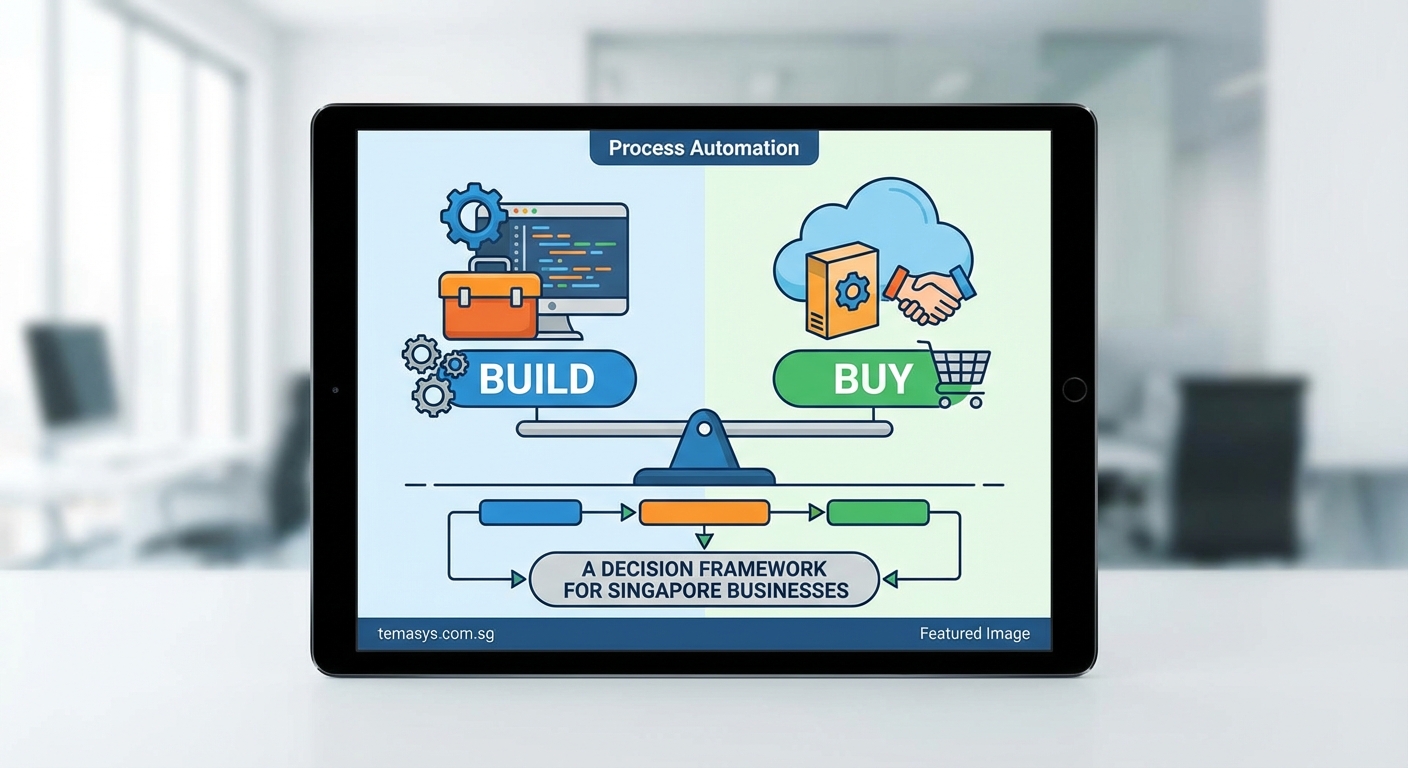
The build vs buy automation software decision hinges on five factors: competitive differentiation, total cost of ownership, time to value, internal capabilities, and integration requirements. Most Singapore businesses should buy for commodity functions and build only for unique competitive advantages. This framework helps you evaluate each option systematically and avoid costly mistakes that drain resources.
Understanding the Real Stakes Behind This Decision
Let’s be honest. This isn’t just about software. It’s about your company’s future.
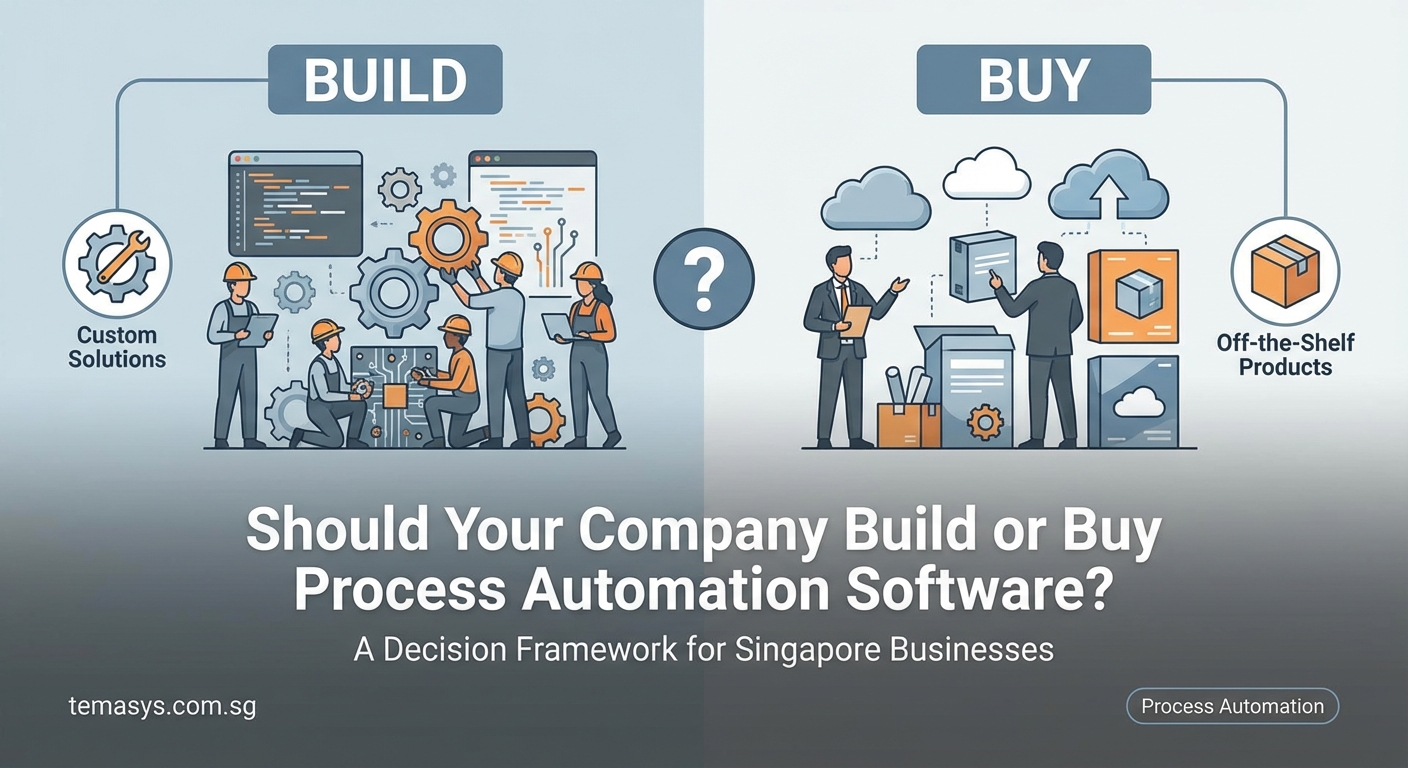
When you build custom automation software, you’re betting on your team’s ability to create, maintain, and evolve a solution that matches or exceeds commercial alternatives. You’re committing to years of development, testing, and support.
When you buy, you’re betting that an existing platform can adapt to your needs. You’re trading control for speed and accepting that you’ll work within someone else’s framework.
Both paths have led companies to spectacular success. Both have also led to spectacular failures.
The difference? Knowing which path matches your specific situation.
The Five Critical Factors That Should Drive Your Choice
Factor 1: Competitive Differentiation
Start here. Always.
Ask yourself: will this automation create a competitive advantage, or will it simply help you keep up with industry standards?
If you’re a logistics company and you’ve invented a revolutionary route optimization algorithm that cuts delivery times by 40%, build it. That’s your secret sauce. Buying off-the-shelf routing software means your competitors can buy the same advantage.
If you need to automate invoice processing, buy it. Every company processes invoices. There’s no competitive edge in building your own accounts payable system.
Here’s a simple test: if your competitors would pay to copy your process, build it. If they already have something similar, buy it.
Factor 2: Total Cost of Ownership
Most companies underestimate build costs by 200% to 300%. Not because they’re bad at math, but because they forget the hidden expenses.
Building means you pay for:
- Initial development (developers, project managers, designers)
- Testing and quality assurance
- Infrastructure and hosting
- Ongoing maintenance and bug fixes
- Feature enhancements and updates
- Security patches and compliance updates
- Documentation and training materials
- Staff turnover and knowledge transfer
Buying means you pay for:
- Licensing fees (monthly or annual)
- Implementation and configuration
- Integration with existing systems
- Training for end users
- Customisation (if allowed)
- Ongoing support fees
- Upgrade costs
The real cost comparison happens over five years, not one. A S$50,000 initial build might cost S$300,000 over five years when you factor in maintenance. A S$100,000 annual license might include all updates, support, and new features.
Understanding implementation costs helps you budget accurately for either path.
Factor 3: Time to Value
Speed matters more than most executives admit.
Building custom software typically takes 12 to 24 months before you see real value. That’s a year or two of continuing with broken processes while your competitors automate.
Buying and implementing existing software typically takes 3 to 6 months. You’re operational faster, you see ROI sooner, and you can redirect your IT team to other priorities.
But here’s the catch: if you need something truly unique, buying might mean endless customisation that takes just as long as building. Or worse, you might compromise your processes to fit the software’s limitations.
Factor 4: Internal Capabilities
Be brutally honest about your team’s skills.
Building requires:
- Experienced software architects
- Skilled developers in relevant technologies
- DevOps engineers for deployment
- Security specialists
- Project managers who’ve shipped software before
- Quality assurance professionals
Most Singapore SMEs don’t have this bench strength. They have one or two developers who already juggle multiple responsibilities.
Even if you hire contractors to build the initial version, you’ll need internal staff to maintain it. What happens when your lead developer leaves and takes all the knowledge with them?
Buying requires different skills:
- Business analysts who can map processes
- Integration specialists
- Change management professionals
- Training coordinators
These skills are often easier to source or outsource.
Factor 5: Integration Requirements
Your new automation software doesn’t exist in a vacuum. It needs to talk to your existing systems.
Modern commercial software comes with pre-built connectors to popular platforms. Need to connect your automation tool to Salesforce, SAP, or Microsoft 365? Most vendors have done this hundreds of times.
Custom-built solutions require you to build every integration from scratch. Each API connection becomes a project. Each data sync becomes a maintenance headache.
However, if you’re working with legacy systems or proprietary databases, commercial software might not support them. In those cases, building gives you complete control over integration architecture.
Connecting business systems seamlessly becomes easier when you choose platforms designed for integration.
A Framework for Making Your Decision
Follow this process to evaluate your specific situation:
- List every business process you want to automate
- Score each process on competitive differentiation (1-10, where 10 is highly differentiating)
- Estimate the complexity of each process (simple, moderate, complex)
- Calculate the total cost of building vs buying for each process
- Assess your team’s capability to build and maintain each solution
- Make the build vs buy decision process by process, not as a single choice
Most companies end up with a hybrid approach. They buy commodity automation and build differentiating features.
When Building Makes Strategic Sense
Build when you can confidently answer yes to all these questions:
- Does this automation create measurable competitive advantage?
- Do we have (or can we hire) the technical talent needed?
- Can we commit to 3-5 years of ongoing development and maintenance?
- Is the total cost of building genuinely lower than buying?
- Have we failed to find commercial software that meets our core needs?
“We built our warehouse management system because our multi-temperature storage requirements were unique to Singapore’s climate and our business model. Off-the-shelf solutions couldn’t handle the complexity. Three years later, it’s still our competitive edge.” – Operations Director, Cold Chain Logistics Company
Building works best for:
- Proprietary algorithms and business logic
- Highly specialised industry processes
- Integration with rare or custom legacy systems
- Situations where you need complete data control for regulatory reasons
When Buying Makes More Sense
Buy when these conditions apply:
- The process is common across your industry
- Multiple vendors offer mature solutions
- You need to go live within 6 months
- Your IT team is already stretched thin
- The software vendor has a strong track record in your region
Most Singapore businesses should buy for:
- Customer relationship management
- Financial management and accounting
- Human resources and payroll
- Email marketing and communications
- Project management
- Document management
- Basic workflow automation
These are solved problems. Thousands of companies have automated these processes successfully. You don’t need to reinvent the wheel.
Avoiding common software selection mistakes saves time and money during the buying process.
The Hybrid Approach That Works for Most Companies
Here’s what successful Singapore companies actually do: they buy platforms and build on top of them.
They purchase robust automation platforms with strong APIs and customisation capabilities. Then they build their unique processes as extensions or integrations.
This approach gives you:
- Fast time to value for standard processes
- Flexibility to customise what matters
- Vendor support for core functionality
- Control over competitive differentiators
For example, you might buy a standard ERP system but build custom reporting dashboards that give you insights your competitors don’t have. Or you might buy marketing automation software but build custom scoring algorithms based on your unique customer data.
Evaluating Commercial Software Options
If you decide to buy, use this evaluation framework:
| Evaluation Criteria | What to Look For | Red Flags to Avoid |
|---|---|---|
| Vendor Stability | 5+ years in business, strong customer base | Frequent leadership changes, vague financials |
| Feature Completeness | Covers 80%+ of your requirements out of box | Promises to build features “soon” |
| Integration Capability | Pre-built connectors to your existing tools | Requires custom coding for basic integrations |
| Local Support | Singapore-based support team, local references | Offshore-only support, no regional presence |
| Scalability | Handles 3x your current transaction volume | Performance degrades with data growth |
| Customisation | Configurable without code changes | Requires vendor professional services for minor tweaks |
| Data Ownership | Clear data export and portability | Proprietary formats, difficult extraction |
| Pricing Transparency | Clear pricing tiers, predictable costs | Hidden fees, surprise charges for basic features |
Choosing between cloud and on-premise deployment adds another layer to your evaluation.
Common Mistakes That Drain Resources
Avoid these pitfalls that we see repeatedly:
Building when you should buy:
- Underestimating maintenance costs
- Overestimating your team’s capabilities
- Ignoring opportunity cost of tying up developers
- Failing to account for staff turnover
Buying when you should build:
- Compromising core business processes to fit the software
- Paying for features you’ll never use
- Getting locked into vendor ecosystems
- Accepting limitations that hurt competitiveness
Poor execution of either approach:
- Skipping the requirements phase
- Failing to involve end users early
- Ignoring change management
- Underinvesting in training
- Not planning for integration needs
Preparing your organisation properly prevents many of these mistakes regardless of which path you choose.
Making the Business Case to Leadership
You’ve done the analysis. You know which direction makes sense. Now you need to convince the board or executive team.
Structure your business case around these elements:
Executive Summary:
- Clear recommendation (build, buy, or hybrid)
- Expected ROI and payback period
- Key risks and mitigation strategies
Strategic Alignment:
- How this supports business objectives
- Competitive implications
- Long-term scalability
Financial Analysis:
- Total cost of ownership over 5 years
- Cash flow implications
- Resource requirements
Risk Assessment:
- Technical risks
- Vendor risks (if buying)
- Execution risks
- Mitigation plans for each
Implementation Plan:
- Timeline with key milestones
- Resource allocation
- Success metrics
Building a CFO-approved business case increases your chances of securing budget and support.
Signs Your Business Needs Automation Now
Watch for these indicators that automation can’t wait:
- Manual processes consuming more than 20 hours per week per employee
- Error rates above 5% in critical processes
- Customer complaints about slow response times
- Inability to scale operations without proportional headcount increases
- Competitors moving faster than you
- Compliance risks from manual record-keeping
- Key staff leaving because processes are frustrating
- Missing revenue opportunities due to slow quote turnaround
- Inventory issues from poor visibility
- Cash flow problems from delayed invoicing
Recognising when it’s time to upgrade helps you act before problems become crises.
The Role of Change Management in Success
Here’s an uncomfortable truth: most automation projects fail not because of technology, but because of people.
Your shiny new system, whether built or bought, is worthless if your team won’t use it.
Successful automation requires:
- Executive sponsorship that’s visible and active
- Early involvement of end users in design decisions
- Clear communication about why change is happening
- Comprehensive training that goes beyond button-clicking
- Support structures for the transition period
- Recognition and rewards for adoption
- Patience as people adjust to new workflows
Overcoming resistance to digital change becomes easier when you plan for it from day one.
How Singapore’s Business Environment Influences the Decision
Local factors matter when making the build vs buy automation software choice.
Singapore’s tight labour market makes hiring and retaining developers expensive and challenging. This tilts the equation toward buying for most companies.
Strong intellectual property protections mean you can build proprietary systems without excessive fear of theft. This supports building when you have genuine innovations.
Government grants and incentives often favour digital transformation projects that use established vendors. Check schemes like the Productivity Solutions Grant before deciding.
The multicultural business environment means your automation needs to handle multiple languages, currencies, and regulatory frameworks. Commercial software often includes this out of the box.
Singapore’s position as a regional hub means your automation might need to scale across Southeast Asia. Consider whether your build approach can handle this complexity.
Vendor Selection Criteria That Actually Matter
If you’re buying, choosing the right vendor is as important as choosing the right software.
Look beyond the demo. Every vendor can make their software look good in a 60-minute presentation.
Instead, focus on:
- Customer retention rates (above 90% is good)
- Average implementation time (compare to their promises)
- References from companies similar to yours
- Financial stability and growth trajectory
- Product development velocity (how often do they release updates?)
- Quality of documentation and training materials
- Responsiveness during the sales process (it only gets worse after you sign)
Identifying vendor red flags and green lights protects you from costly mistakes.
Real-World Example: Manufacturing Company’s Journey
A Singapore-based precision engineering company faced this exact decision last year.
They needed to automate their production planning process. Their unique challenge: they manufactured custom parts with lead times ranging from 2 days to 6 months, all running through the same facility.
Their evaluation:
They considered building because their scheduling algorithm was complex and potentially differentiating. They also looked at three commercial manufacturing execution systems.
The decision:
They bought a flexible MES platform and built their custom scheduling logic as a module on top of it. The platform handled shop floor data collection, quality management, and reporting. Their custom module handled the complex scheduling.
The result:
They went live in 7 months instead of the 18 months building from scratch would have taken. They spent S$180,000 on software and implementation instead of the estimated S$400,000 to build everything custom.
Most importantly, they got their competitive advantage (the scheduling algorithm) while leveraging proven technology for everything else.
Similar success stories show this hybrid approach working across industries.
Planning Your Implementation Timeline
Realistic timelines prevent disappointment and budget overruns.
For buying commercial software:
- Months 1-2: Requirements gathering and vendor selection
- Month 3: Contract negotiation and project kickoff
- Months 4-5: Configuration, integration, and testing
- Month 6: Training and go-live
- Months 7-12: Optimisation and refinement
For building custom software:
- Months 1-3: Requirements, architecture, and design
- Months 4-12: Development and testing
- Months 13-15: User acceptance testing and refinement
- Month 16: Training and deployment
- Months 17-24: Bug fixes and enhancement requests
Notice the difference? Buying gets you to value in half the time.
Creating a realistic implementation roadmap helps you set proper expectations with stakeholders.
Measuring Success After Implementation
Define success metrics before you start, not after you finish.
Track these key indicators:
Efficiency Metrics:
- Time saved per process
- Reduction in manual data entry
- Decrease in error rates
- Increase in throughput
Financial Metrics:
- Cost per transaction
- Labour cost reduction
- Revenue enabled by faster processes
- ROI and payback period
User Adoption Metrics:
- Percentage of staff actively using the system
- Transaction volume through automated processes
- Support tickets related to the system
- User satisfaction scores
Business Impact Metrics:
- Customer satisfaction improvements
- Faster time to market
- Increased capacity without headcount growth
- Compliance improvements
Set baseline measurements before implementation. Track monthly after go-live. Be honest about what’s working and what isn’t.
The Infrastructure Decision You Can’t Ignore
Whether you build or buy, you need to decide where your automation software will run.
Cloud-based solutions offer:
- Lower upfront infrastructure costs
- Automatic updates and patches
- Easy scalability
- Access from anywhere
- Disaster recovery built in
On-premise solutions offer:
- Complete data control
- No ongoing cloud fees
- Customisation flexibility
- Independence from internet connectivity
Most commercial software now defaults to cloud deployment. If you’re building, you’ll need to make this choice explicitly.
Choosing the right infrastructure approach affects both cost and capability.
What to Do When Your First Choice Fails
Sometimes you make the wrong call. You build when you should have bought. Or you buy software that doesn’t deliver.
Don’t throw good money after bad.
If your custom build is 6 months late and 200% over budget with no end in sight, stop. Reassess whether commercial alternatives have emerged. Calculate the cost to finish versus the cost to switch.
If your purchased software isn’t meeting needs after a genuine implementation effort, don’t keep paying license fees hoping it will improve. Cut your losses and try a different approach.
The sunk cost fallacy kills projects. The money you’ve already spent is gone. Make decisions based on future costs and benefits, not past investments.
Understanding why digital projects fail helps you recognise problems early.
Your Decision Framework Checklist
Use this final checklist before committing to either path:
Strategic Questions:
- [ ] Does this automation create competitive advantage or match industry standards?
- [ ] Will this capability matter in 5 years?
- [ ] Are we solving a unique problem or a common one?
Financial Questions:
- [ ] Have we calculated 5-year total cost of ownership for both options?
- [ ] Do we have budget for ongoing maintenance and enhancements?
- [ ] What’s the expected ROI and payback period?
Capability Questions:
- [ ] Do we have the internal skills needed for our chosen approach?
- [ ] Can we commit the required resources without compromising other priorities?
- [ ] What happens if key team members leave?
Risk Questions:
- [ ] What could go wrong with each approach?
- [ ] How will we mitigate the top three risks?
- [ ] Do we have a backup plan if our first choice fails?
Execution Questions:
- [ ] Have we involved end users in this decision?
- [ ] Is leadership truly committed to supporting this project?
- [ ] Do we have a realistic timeline and resource plan?
Making This Decision Work for Your Business
The build vs buy automation software decision isn’t about finding the “right” answer. It’s about finding the right answer for your specific business at this specific time.
Your competitor might build successfully while you buy successfully. Or vice versa. What matters is matching the approach to your strategy, capabilities, and constraints.
Start with competitive differentiation. If automation gives you an edge, lean toward building. If it just helps you keep up, lean toward buying. Then validate that instinct against costs, timelines, and capabilities.
Most Singapore businesses will end up buying more than they build. That’s not a failure of ambition. It’s smart resource allocation that lets you focus your limited IT capacity on what truly differentiates your business.
The companies that win aren’t the ones with the most custom code or the most vendor relationships. They’re the ones that automate intelligently, implement successfully, and adapt continuously.
Make your choice based on evidence, not ego. Then execute with commitment and flexibility.
Leave a Reply