
Choosing the wrong vendor for your digital transformation project can cost your organisation millions and set you back years. The stakes are high, and the sales pitches all sound convincing. But behind the polished demos and confident promises, some vendors simply aren’t equipped to deliver what your business needs.
Successful digital transformation vendor selection depends on spotting red flags like rigid contracts, vague demos, and poor support structures whilst identifying green flags such as transparent pricing, proven implementation methodology, and genuine industry expertise. The right partner invests time understanding your business before proposing solutions and demonstrates commitment beyond the initial sale through ongoing support and scalability.
Warning signs that should make you pause
Some vendor behaviours signal trouble before you even sign a contract. Recognising these patterns early can save your project from disaster.
They rush you into long-term commitments
A vendor pushing for multi-year contracts before you’ve tested their solution is a massive red flag. Good vendors understand that trust is earned, not demanded upfront.
If they’re pressuring you to sign before you’ve had adequate time to evaluate, they’re prioritising their sales targets over your success. This often indicates they lack confidence in their ability to retain customers based on performance alone.
Watch for contract terms that make it prohibitively expensive to exit. Some vendors build their business model around customer lock-in rather than customer satisfaction.
Their demo feels like theatre, not a working session
Generic demonstrations that showcase features without addressing your specific workflows are essentially useless. A vendor who hasn’t taken time to understand your business can’t possibly show you how their solution solves your actual problems.
During the demo, ask to see how the system handles your unique edge cases. If they deflect or promise “we’ll configure that later,” you’re looking at a vendor who may not have the flexibility you need.
The best vendors arrive prepared with examples relevant to your industry and use cases that mirror your daily operations. They ask questions during the demo to refine their understanding, not just to fill time.
Communication becomes inconsistent or vague
Pay attention to response times and clarity during the evaluation phase. If a vendor is slow to respond or provides evasive answers to direct questions now, imagine how frustrating support will be after they have your money.
Vendors who overpromise without understanding your requirements are setting you up for disappointment. They’re telling you what you want to hear rather than what’s actually achievable.
Look for vendors who are honest about limitations and realistic about timelines. This transparency is rare but invaluable.
Their pricing structure is opaque or constantly shifting
Hidden costs are endemic in enterprise software. If a vendor can’t provide clear, itemised pricing that includes implementation, training, customisation, and ongoing support, they’re likely hiding something.
Watch for proposals that seem too good to be true. Low initial quotes often balloon once you’re committed and discover the “extras” needed for basic functionality.
A trustworthy vendor breaks down costs clearly and explains what drives pricing variations. They should be able to give you a realistic total cost of ownership, not just the licence fee. Understanding how much ERP implementation really costs for Singapore SMEs in 2024 helps you spot unrealistic proposals.
They lack verifiable customer references in your industry
A vendor without customers in your sector or of your size is taking you on as an experiment. You’ll be funding their learning curve.
When they provide references, actually call them. Ask specific questions about implementation challenges, ongoing support quality, and whether the vendor delivered on their promises.
Be suspicious if all references are glowing without mentioning any challenges. Real implementations always have bumps. Honest customers and vendors acknowledge this.
Their implementation methodology is unclear or non-existent
Vendors who can’t articulate a structured implementation process are making it up as they go. This leads to scope creep, missed deadlines, and budget overruns.
Ask to see their project plan template, change management approach, and how they handle data migration. Vague answers here predict chaos later.
Positive indicators of a reliable partner
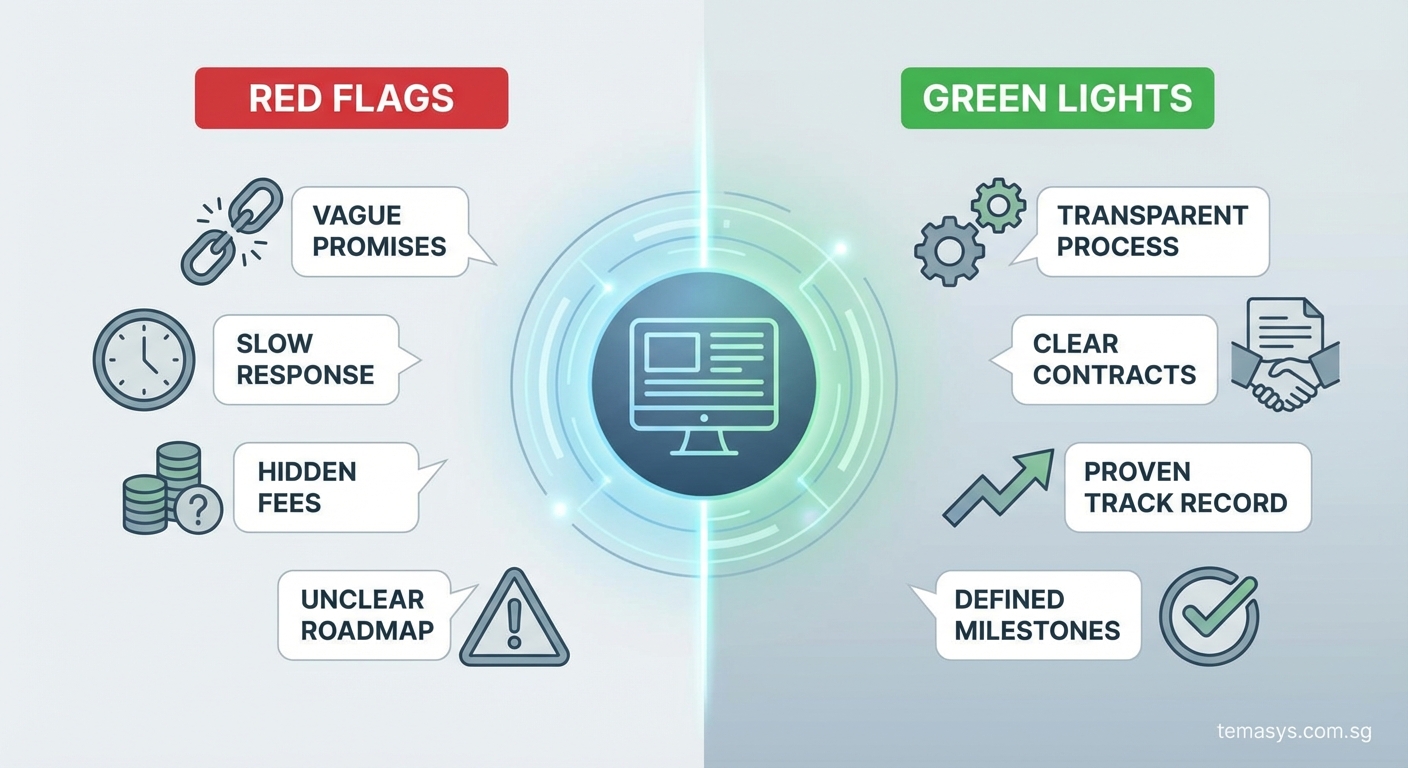
Not all vendor relationships end in frustration. Some partnerships genuinely transform businesses. Here’s what separates the excellent from the mediocre.
They invest time understanding your business before proposing solutions
The best vendors act like consultants first and salespeople second. They ask about your current pain points, future growth plans, team structure, and existing technology stack before recommending anything.
This discovery process should feel collaborative. They’re learning from you, and you’re learning from their questions. Good vendors help you articulate needs you hadn’t fully recognised.
If a vendor can explain your business challenges back to you in your own language, they’ve done their homework. This understanding is foundational to successful implementation.
They provide transparent, fixed-scope pricing for defined deliverables
Clear pricing demonstrates respect for your budget and planning process. Vendors confident in their methodology can estimate accurately.
Look for proposals that tie costs to specific deliverables and milestones. This structure protects both parties and creates accountability.
The best vendors also discuss what might cause scope changes and how those are handled. This proactive communication prevents nasty surprises mid-project.
Their support structure is robust and clearly defined
Support quality determines whether your system becomes a business asset or a constant headache. Vendors should clearly explain response times, escalation procedures, and support hours.
Ask about their support team structure. Are you getting offshore support reading from scripts, or local experts who understand Singapore business requirements?
Check if they offer different support tiers and what each includes. Understanding these options helps you budget appropriately and set realistic expectations.
They demonstrate genuine expertise in your industry
Industry knowledge isn’t just nice to have. It’s essential. Vendors who understand your regulatory environment, seasonal patterns, and competitive pressures can configure solutions that actually fit.
They should be able to discuss industry trends and how their solution addresses emerging challenges. This forward thinking indicates they’re investing in product development relevant to your sector.
Look for vendors who participate in industry associations, publish thought leadership, and employ consultants with hands-on experience in your field.
They’re committed to your success beyond the initial sale
The relationship doesn’t end at go-live. The best vendors provide ongoing optimisation, training for new staff, and regular business reviews to ensure you’re maximising value.
Ask about their customer retention rates and average relationship length. High retention suggests they deliver sustained value.
Vendors who proactively suggest improvements and new features based on your evolving needs are invested in your long-term success, not just the initial contract.
A practical framework for vendor evaluation
Here’s a systematic approach to assessing potential partners without getting overwhelmed by the options.
Step 1: Define your requirements before talking to vendors
Document your must-have features, nice-to-have features, and absolute deal-breakers. This clarity prevents vendors from steering you toward what they sell rather than what you need.
Include technical requirements like integration needs, data security standards, and scalability expectations. If you’re considering cloud ERP vs on-premise solutions, clarify this before vendor conversations begin.
Share these requirements with your evaluation team so everyone assesses vendors against the same criteria.
Step 2: Create a standardised evaluation scorecard
Rate each vendor consistently across key dimensions. This removes emotion and politics from the decision.
| Evaluation Criterion | Weight | Vendor A Score | Vendor B Score | Vendor C Score |
|---|---|---|---|---|
| Industry expertise | 20% | |||
| Implementation methodology | 15% | |||
| Total cost of ownership | 20% | |||
| Support quality | 15% | |||
| Technology fit | 15% | |||
| Customer references | 10% | |||
| Cultural alignment | 5% |
Assign weights based on your priorities. What matters most to one organisation may be less critical to another.
Step 3: Conduct thorough reference checks
Don’t just accept the references vendors provide. Search for customers they didn’t mention. Online communities and LinkedIn can reveal unfiltered experiences.
Questions to ask references:
- What surprised you during implementation?
- How does the vendor handle problems?
- Would you choose them again knowing what you know now?
- What should we specifically ask about or watch for?
- How accurate were their initial timelines and budgets?
Listen for what they don’t say as much as what they do. Hesitation or diplomatic language often signals problems they’re uncomfortable discussing directly.
Step 4: Test with a pilot or proof of concept
Whenever possible, run a limited pilot before full commitment. This reveals how the vendor performs under real conditions with your actual data and users.
A pilot also exposes your team to the solution and surfaces concerns or requirements you hadn’t anticipated. Many organisations discover critical mistakes when choosing ERP software during this phase.
Evaluate not just the technology but how the vendor manages the pilot. Their responsiveness, problem-solving approach, and flexibility during this phase predict future collaboration quality.
Step 5: Involve end users in the evaluation
The people who will use the system daily often spot usability issues that management overlooks. Their buy-in is also critical for adoption success.
Create a cross-functional evaluation team including:
- IT leadership for technical assessment
- Finance for budget and ROI analysis
- Department heads for functional requirements
- End users for usability feedback
- Legal for contract review
Each perspective catches different issues. A solution that looks perfect to IT might be unusable for the sales team who needs mobile access in the field.
Common mistakes that derail vendor selection
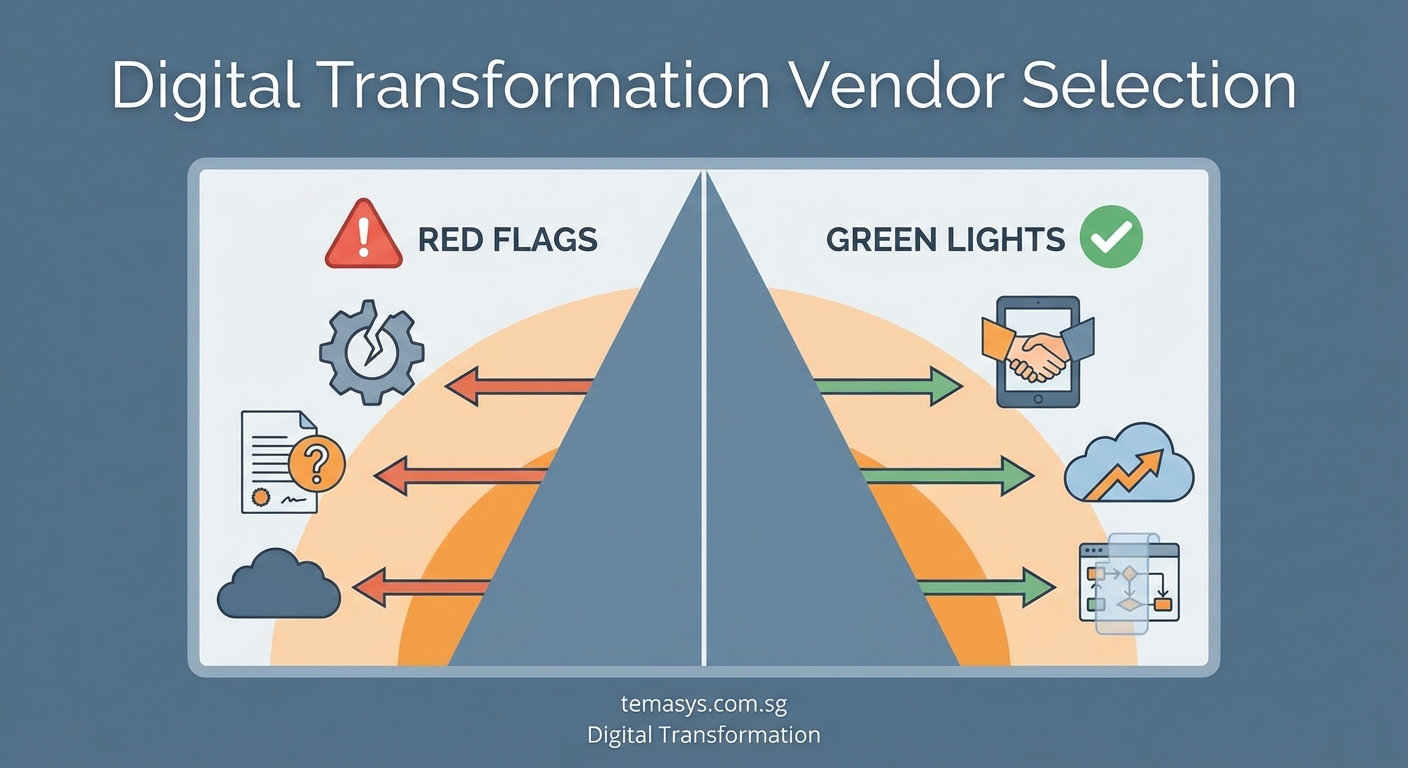
Even experienced leaders make predictable errors when choosing technology partners. Avoid these traps.
Focusing solely on features rather than fit. The system with the longest feature list isn’t necessarily the best choice. You need features that match your workflows, not a bloated system where 60% of capabilities sit unused.
Underestimating implementation complexity. The software purchase is often the smallest part of total cost. Implementation, customisation, data migration, training, and change management typically cost 2-5 times the licence fees.
Ignoring the vendor’s financial stability. A vendor going through financial difficulties may cut support staff, slow product development, or even shut down. Check their financial health, especially for smaller vendors.
Letting one charismatic salesperson drive the decision. Sales skills don’t equal delivery capability. Meet the actual implementation team, not just the sales team.
Skipping the contract negotiation. Everything is negotiable before you sign. Service levels, exit clauses, price escalation caps, and customisation ownership should all be discussed and documented.
“The biggest mistake we made was assuming the vendor understood our business because they had other clients in our industry. We should have insisted on seeing specific examples of how they solved problems identical to ours, not just similar ones.” – CTO, Singapore manufacturing firm
Red flags versus legitimate concerns
Not every concern is a deal-breaker. Learning to distinguish between warning signs and normal business considerations is important.
| Red Flag (Walk Away) | Legitimate Concern (Discuss and Resolve) |
|---|---|
| Vendor refuses to provide customer references | Vendor has few references in your specific sub-industry |
| Contract has no exit clause or punitive termination fees | Contract has standard notice period requirements |
| Vendor can’t explain their implementation process | Vendor’s process needs adaptation for your situation |
| Pricing changes significantly between meetings | Pricing varies based on scope clarifications |
| Support team is unreachable during evaluation | Support response is slower during holiday periods |
| Demo shows generic features with no customisation | Demo focuses on core features before discussing customisation |
| Vendor dismisses your concerns or requirements | Vendor explains why certain requirements may not be best practice |
The difference often comes down to transparency and willingness to address issues. Good vendors acknowledge concerns and work with you to resolve them. Bad vendors deflect, minimise, or make promises they can’t keep.
Building a long-term partnership, not just buying software
The vendor relationship should evolve as your business grows. The best partnerships adapt to changing needs.
Look for vendors who offer:
- Regular business reviews to assess system performance
- Training programmes for new employees
- User communities where customers share best practices
- Clear product roadmaps so you can plan for future capabilities
- Flexibility to scale up or down as your business changes
These elements indicate a vendor thinking beyond the initial sale. They’re building a business model based on customer success, not just customer acquisition.
Ask how they handle product updates and new releases. Forced upgrades that break customisations are frustrating and expensive. Vendors who support multiple versions or provide clear migration paths respect your operational stability.
Consider also how they approach ERP integration with your existing business systems, as this often determines whether the solution truly transforms operations or just adds complexity.
When to trust your instincts
Data and scorecards are valuable, but sometimes your gut tells you something isn’t right. Pay attention to that feeling.
If interactions with the vendor feel adversarial during the sales process, they won’t improve after the contract is signed. You’re entering a multi-year relationship. It should feel collaborative from the start.
Cultural fit matters more than many organisations realise. A vendor whose communication style, work pace, and values align with yours will navigate challenges more smoothly.
Trust is built through consistent small actions. Vendors who do what they say, when they say, during the evaluation process will likely maintain that reliability during implementation.
Making the final decision with confidence
You’ve done the research, scored the vendors, and checked references. Now you need to decide.
Gather your evaluation team for a final discussion. Review scores, but also discuss intangibles like trust, cultural fit, and long-term vision alignment.
Consider creating a decision matrix that weighs both quantitative scores and qualitative factors. This structured approach helps when team members disagree.
Document your decision rationale. This serves two purposes: it forces clarity in your thinking, and it provides a reference point if questioned later by stakeholders who weren’t involved in the evaluation.
Remember that no vendor is perfect. You’re looking for the best fit, not perfection. The right partner acknowledges their limitations and works with you to address them.
Your next steps start here
Vendor selection isn’t a process you can rush. The time invested in thorough evaluation pays dividends throughout the implementation and beyond.
Start by documenting your requirements clearly. This foundation guides every subsequent decision and conversation. Preparing your organisation for ERP implementation success begins with this clarity.
Then build your evaluation team with diverse perspectives. The best decisions incorporate technical, financial, operational, and user viewpoints.
Finally, remember that you’re choosing a partner, not just a product. The relationship quality often matters more than feature checklists. Look for vendors who demonstrate genuine interest in your success, transparent communication, and proven expertise in delivering results for businesses like yours.
The right vendor transforms your operations. The wrong one becomes an expensive lesson. Take the time to choose wisely.
Leave a Reply