
The logistics landscape in Indonesia is under pressure. Companies operating across the archipelago face mounting challenges that their existing systems simply cannot solve. From fragmented islands to complex customs regulations, the infrastructure demands are unlike anywhere else in Southeast Asia.
Indonesia logistics system challenges stem from geographic complexity, regulatory fragmentation, legacy technology limitations, and inadequate real-time visibility. Companies face port congestion, customs delays, inventory inaccuracies, and rising operational costs. Modern cloud-based systems offer integrated solutions that address multi-location coordination, compliance tracking, and data-driven decision-making across the archipelago’s unique supply chain environment.
The geographic reality behind Indonesia logistics system challenges
Indonesia spans 17,000 islands across three time zones. Moving goods from Jakarta to Papua involves ocean freight, multiple transshipment points, and unpredictable weather patterns.
This geographic spread creates bottlenecks that software designed for single-country operations cannot handle.
Your warehouse in Surabaya operates on different lead times than your distribution centre in Medan. A legacy system built for one location struggles to coordinate inventory across multiple islands. You end up with stock-outs in one region while another sits on excess inventory.
Port congestion compounds the problem. Tanjung Priok handles millions of containers annually, yet delays remain common. Without real-time tracking, your team cannot anticipate disruptions or reroute shipments.
The infrastructure gaps are real. Roads connecting ports to distribution centres vary dramatically in quality. What works in Java fails in Kalimantan.
Why legacy systems cannot keep pace with regulatory complexity
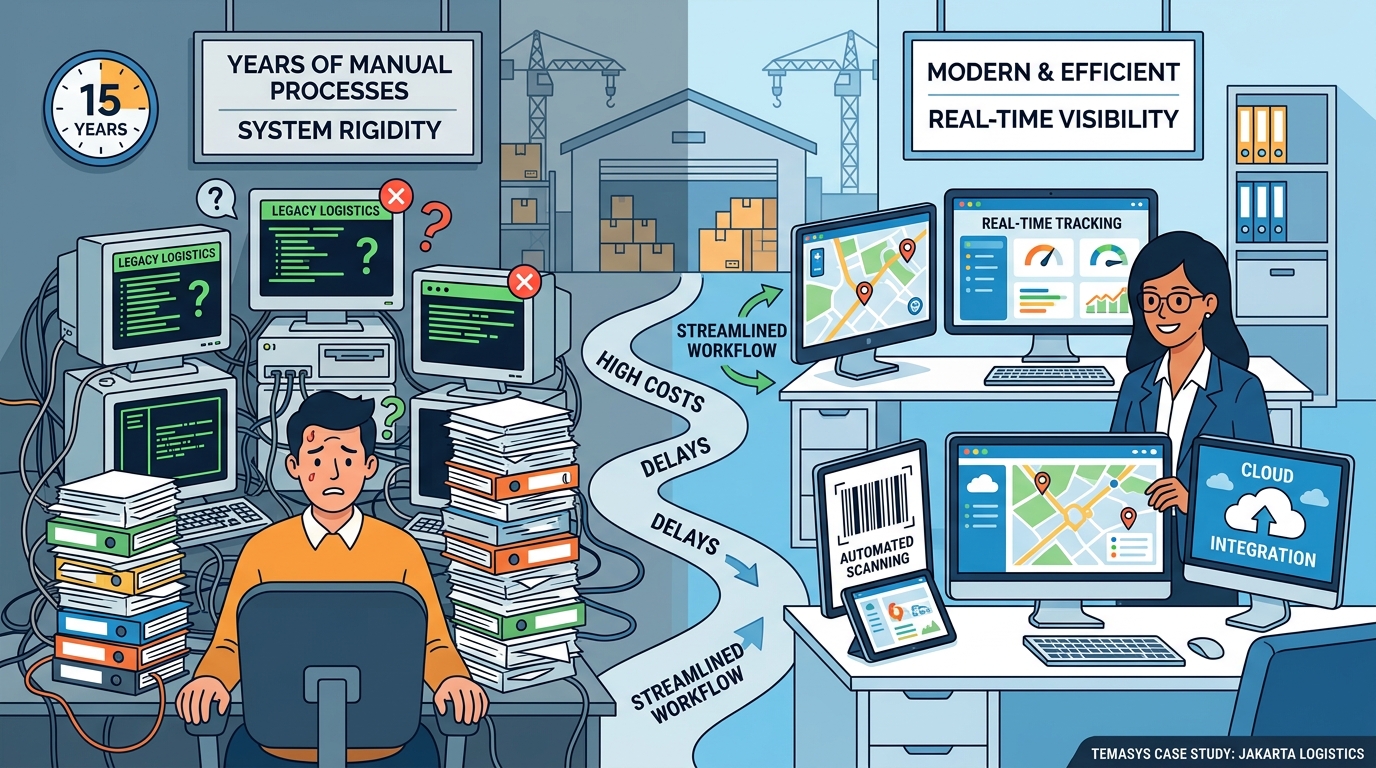
Indonesia’s customs and compliance requirements change frequently. New import regulations, tax codes, and documentation standards roll out with little notice.
Legacy systems require manual updates for each regulatory change. Your IT team spends weeks reconfiguring workflows instead of improving operations.
Consider the recent changes to import licensing requirements. Companies using outdated software had to manually verify compliance for each shipment. Those with modern systems automated the checks and avoided costly delays.
Customs clearance involves multiple government agencies. Your shipment might need approval from the Ministry of Trade, the Ministry of Agriculture, and local port authorities. Legacy systems cannot integrate these touchpoints into a single workflow.
The cost of non-compliance is steep. Fines, storage fees, and demurrage charges accumulate when paperwork errors delay clearance. One missing document can hold up a container for days.
Modern logistics operations require systems that update compliance rules automatically and flag potential issues before shipments reach the port. Reactive approaches no longer work in Indonesia’s regulatory environment.
The hidden costs of poor inventory visibility
Most Indonesia logistics system challenges trace back to one core issue: you cannot manage what you cannot see.
Legacy systems offer snapshots, not real-time data. Your inventory count reflects yesterday’s reality, not today’s. By the time you spot a discrepancy, the damage is done.
Here’s what poor visibility costs:
- Excess safety stock tying up working capital
- Rush orders and expedited shipping fees
- Lost sales from stock-outs
- Write-offs from expired or damaged goods
- Customer churn from unreliable delivery
A Jakarta-based distributor we spoke with carried 40% excess inventory because their system could not track stock levels across five warehouses. They assumed high safety stock would prevent shortages. Instead, they ran out of fast-moving items while slow movers gathered dust.
The problem multiplies when you operate across multiple islands. Without integrated systems, each location becomes a data silo. Your Bali warehouse has no visibility into what’s available in Makassar.
Manual reconciliation eats up staff time. Your team spends hours on spreadsheets instead of strategic work. Errors creep in. Trust in the data erodes.
Common operational failures in Indonesian supply chains
| Challenge | Legacy System Response | Impact on Operations |
|---|---|---|
| Multi-location coordination | Manual phone calls and emails | Delayed responses, miscommunication, duplicate orders |
| Customs documentation | Paper-based filing systems | Missing documents, compliance errors, port delays |
| Carrier performance tracking | Spreadsheet logs | No accountability, repeated service failures |
| Demand forecasting | Historical averages only | Overstocking slow movers, understocking trending items |
| Returns processing | Separate system or manual logs | Lost inventory, customer frustration, revenue leakage |
These failures compound. A documentation error delays customs clearance. Your inventory system shows the goods as in transit. Sales promises delivery based on outdated data. The customer receives nothing. Trust breaks down.
The pattern repeats across industries. Manufacturing firms cannot coordinate raw material deliveries with production schedules. Retailers miss seasonal peaks because their forecasting tools lack real-time sales data. Distributors lose customers to competitors with better delivery reliability.
The breaking point for legacy logistics software
Most companies tolerate system limitations until a specific trigger forces change. These breaking points follow predictable patterns.
Rapid growth exposes scalability limits
Your business doubles in size. The software that managed 50 orders daily buckles under 150. Response times slow. Crashes become frequent. Your team develops workarounds that introduce new risks.
Geographic expansion reveals integration gaps
Opening a second or third location should improve customer service. Instead, coordination becomes a nightmare. Each site operates independently. You cannot transfer stock between locations efficiently. Customer orders fall through the cracks.
Compliance violations trigger audits
A single customs violation can prompt a full audit of your operations. If your system cannot produce accurate records, penalties multiply. Some companies face temporary import bans.
Customer expectations shift
B2B buyers now expect the same transparency they get from consumer platforms. They want real-time tracking, accurate delivery windows, and instant order status. Legacy systems cannot deliver this experience.
Key staff depart
Your logistics manager retires. Suddenly, nobody understands the workarounds keeping the old system functional. Tribal knowledge walks out the door. Operations grind to a halt.
What modern logistics systems solve differently
Cloud-based platforms approach Indonesia logistics system challenges with fundamentally different architecture.
1. Real-time data synchronisation across locations
Every warehouse, distribution centre, and retail outlet connects to the same database. When stock moves in Bandung, the system updates instantly. Your Jakarta team sees the change immediately.
2. Automated compliance monitoring
The system tracks regulatory requirements by product category and destination. It flags potential issues before you ship. Documentation generates automatically based on current rules.
3. Integrated carrier management
Track shipments across multiple carriers through a single interface. Compare performance metrics. Identify reliable partners. Switch providers when service degrades.
4. Predictive analytics for demand planning
Machine learning algorithms analyse sales patterns, seasonal trends, and external factors. Forecasts improve over time. You stock what customers actually want.
5. Mobile accessibility for field teams
Drivers, warehouse staff, and sales representatives access the system from smartphones. They update delivery status, capture proof of delivery, and report issues in real time.
These capabilities address the specific pain points that plague Indonesian operations. The technology adapts to your business instead of forcing your business to adapt to software limitations.
How to evaluate if your current system is failing
Run through this assessment honestly. If you answer yes to more than three questions, your system is holding you back.
- Does your team spend more than two hours daily reconciling inventory across locations?
- Have you experienced customs delays due to documentation errors in the past quarter?
- Can you identify your top-performing and worst-performing carriers with current data?
- Do customers regularly ask for order status updates because your system cannot provide tracking?
- Has your inventory carrying cost increased despite stable or declining sales?
- Do you maintain safety stock levels above 30% of average demand?
- Have you lost customers to competitors citing delivery reliability as the reason?
- Does generating a compliance report require manual data compilation?
- Can you accurately forecast demand for your top 20 SKUs?
- Have you postponed geographic expansion due to system limitations?
The questions reveal capability gaps, not just software bugs. You might work around individual issues, but the cumulative effect drags down your entire operation.
Companies often wait too long to address these problems. The cost of inaction exceeds the investment in modern systems. Legacy system migration requires planning, but delaying compounds the challenges.
The implementation reality for Indonesian logistics companies
Switching systems feels risky. You worry about disruption, data migration, and staff resistance.
The actual implementation process follows a structured path:
-
Map current workflows and pain points. Document how work actually happens, not how the manual says it should happen. Identify the biggest bottlenecks.
-
Define success metrics before you start. What does better look like? Faster order processing? Lower carrying costs? Improved on-time delivery? Set measurable targets.
-
Plan data migration in phases. You don’t need to move everything at once. Start with current inventory and active orders. Historical data can migrate later.
-
Run parallel systems during transition. Keep the old system running while you validate the new one. This safety net prevents disasters.
-
Train staff in waves, not all at once. Start with power users. Let them become internal champions. Their success stories convince skeptics.
-
Go live in one location first. Prove the system works before rolling out across all sites. Learn from early mistakes when the stakes are lower.
The timeline varies based on complexity. A single-location distributor might complete migration in six weeks. A multi-island operation with complex workflows needs three to four months.
The key is treating implementation as a business transformation, not just a software installation. Preparing your organisation determines success more than the technology itself.
Cost considerations beyond the software license
ERP implementation costs include several components that catch companies off guard.
Software licensing or subscription fees are just the starting point. Cloud systems typically charge per user per month. Costs scale with your team size.
Implementation services cover system configuration, data migration, and integration with existing tools. This often equals or exceeds the first year’s software costs.
Training and change management ensure your team actually uses the new system effectively. Skimping here guarantees poor adoption.
Integration with existing systems connects your new logistics platform to accounting software, e-commerce platforms, and customer relationship management tools.
Ongoing support and maintenance keeps the system running smoothly. Cloud providers include this in subscription fees. On-premise systems require dedicated IT staff or external support contracts.
The total investment typically ranges from 2% to 5% of annual revenue for mid-sized logistics operations. That might sound steep until you calculate the cost of your current inefficiencies.
One distributor we worked with spent $180,000 annually on excess inventory carrying costs, expedited shipping, and compliance penalties. Their new system cost $85,000 to implement and $24,000 annually to operate. The payback period was seven months.
Choosing between cloud and on-premise for Indonesian operations
Cloud versus on-premise is not just a technology decision. It reflects your operational priorities and constraints.
Cloud systems offer advantages for multi-location operations
Your team accesses the system from anywhere with internet connectivity. Updates deploy automatically. You avoid the complexity of maintaining servers across multiple islands.
Indonesia’s internet infrastructure has improved dramatically. Major cities offer reliable connectivity. Even remote locations can access cloud systems through mobile networks.
On-premise systems provide control over sensitive data
Some companies prefer keeping logistics data on their own servers. Regulatory requirements or competitive concerns drive this choice.
The trade-off is higher upfront costs and ongoing maintenance responsibility. You need IT staff with specific expertise. Hardware refresh cycles add expense every few years.
For most Indonesian logistics operations, cloud systems make more sense. The flexibility, automatic updates, and lower upfront investment align better with the dynamic business environment.
Avoiding the mistakes that derail digital transformation
Common mistakes in software selection follow predictable patterns.
Choosing based on features instead of workflows
A system might offer 200 features, but if it cannot handle your specific workflows, those features are worthless. Map your processes first, then find software that fits.
Underestimating change management
Technology is easy. People are hard. Your team has developed habits around the old system. Breaking those habits requires deliberate effort, not just training sessions.
Skipping the vendor reference checks
Talk to companies similar to yours that use the system. Ask about implementation challenges, ongoing support quality, and whether they would choose the same vendor again.
Ignoring integration requirements
Your logistics system does not operate in isolation. It needs to share data with accounting, e-commerce, and customer service tools. Verify integration capabilities before committing.
Accepting customisation too readily
Every customisation adds complexity, cost, and future upgrade challenges. Push back. Often, changing your process to match the software’s best practices yields better results.
Digital transformation vendor selection requires diligence. The wrong choice costs years, not just money.
Signs your business is ready for system modernisation
Recognising readiness prevents premature or delayed transitions.
You are ready when leadership commits to change, not just talks about it. Budget approval is secured. Someone owns the project with authority to make decisions.
Your team acknowledges current system limitations instead of defending workarounds. They are willing to learn new tools and adapt processes.
You have documented your core workflows. You know which processes are critical and which are negotiable.
Your data is cleaner than you think. Perfect data is a myth. Good enough data that you can validate and improve is sufficient.
You can afford some disruption during transition. No time is perfect, but you have identified a window with lower operational risk.
Building the business case for logistics system investment
Finance teams want numbers, not promises. Building a business case requires quantifying both costs and benefits.
Calculate current inefficiency costs
- Labour hours spent on manual data entry and reconciliation
- Carrying costs for excess inventory
- Revenue lost to stock-outs
- Penalties and fees from compliance failures
- Customer acquisition costs to replace churned accounts
Project implementation costs realistically
- Software licensing or subscription fees
- Implementation services
- Training and change management
- Integration development
- Contingency buffer for unexpected issues
Estimate operational improvements
- Inventory reduction through better visibility
- Labour redeployment to higher-value work
- Reduced expedited shipping costs
- Improved on-time delivery rates
- Customer retention improvements
Set a realistic timeline
Most implementations show measurable improvements within six months. Full ROI typically arrives in 12 to 18 months.
Present the case as risk mitigation, not just cost reduction. Your current system represents growing business risk. Competitors with better systems will capture market share. Regulatory violations could disrupt operations entirely.
What successful logistics transformation looks like
Companies that navigate Indonesia logistics system challenges successfully share common characteristics.
They treat software as an enabler, not a solution. Technology supports better processes. It does not fix broken workflows.
They invest in their people alongside systems. Training continues beyond go-live. They create internal expertise instead of permanent vendor dependence.
They measure progress against specific metrics. On-time delivery rates improve. Inventory turns increase. Customer satisfaction scores rise. These numbers tell the real story.
They remain patient during the transition. The first month is messy. The second month shows promise. By month three, the new normal emerges.
They continue optimising after implementation. Modern systems offer capabilities that take time to fully leverage. Initial deployment covers core needs. Subsequent phases add sophistication.
Making the shift from reactive to strategic logistics
Indonesia logistics system challenges will not disappear. The archipelago’s geography is not changing. Regulations will continue evolving. Competition intensifies.
The question is whether your systems help you navigate these realities or hold you back. Legacy software forces reactive management. You spend your days fighting fires instead of building competitive advantages.
Modern platforms enable strategic thinking. Real-time data reveals patterns. Predictive analytics suggest opportunities. Integration eliminates manual coordination. Your team shifts from transaction processing to relationship building and market development.
The companies thriving in Indonesia’s logistics sector are not necessarily the largest or oldest. They are the ones that invested in systems matching the market’s complexity. They made the difficult decision to abandon familiar but failing technology.
Your competitors are making this shift. Your customers expect the capabilities modern systems provide. The cost of staying with legacy software compounds daily. Start the evaluation process now, even if implementation waits a few months. Understanding your options positions you to move decisively when the right moment arrives.