
Singapore’s enterprise software landscape is shifting faster than most business owners realise. The technologies that seemed futuristic two years ago are now table stakes, and the gap between early adopters and laggards is widening.
If you’re an SME leader or IT manager, you’re probably feeling the pressure. Your competitors are automating processes you still handle manually. Your team is asking for better tools. Your customers expect digital experiences that your current systems can’t deliver.
The good news? You don’t need a massive budget or a team of data scientists to keep pace. You just need to understand which technology trends Singapore enterprises 2025 are prioritising and how to apply them without disrupting your operations.
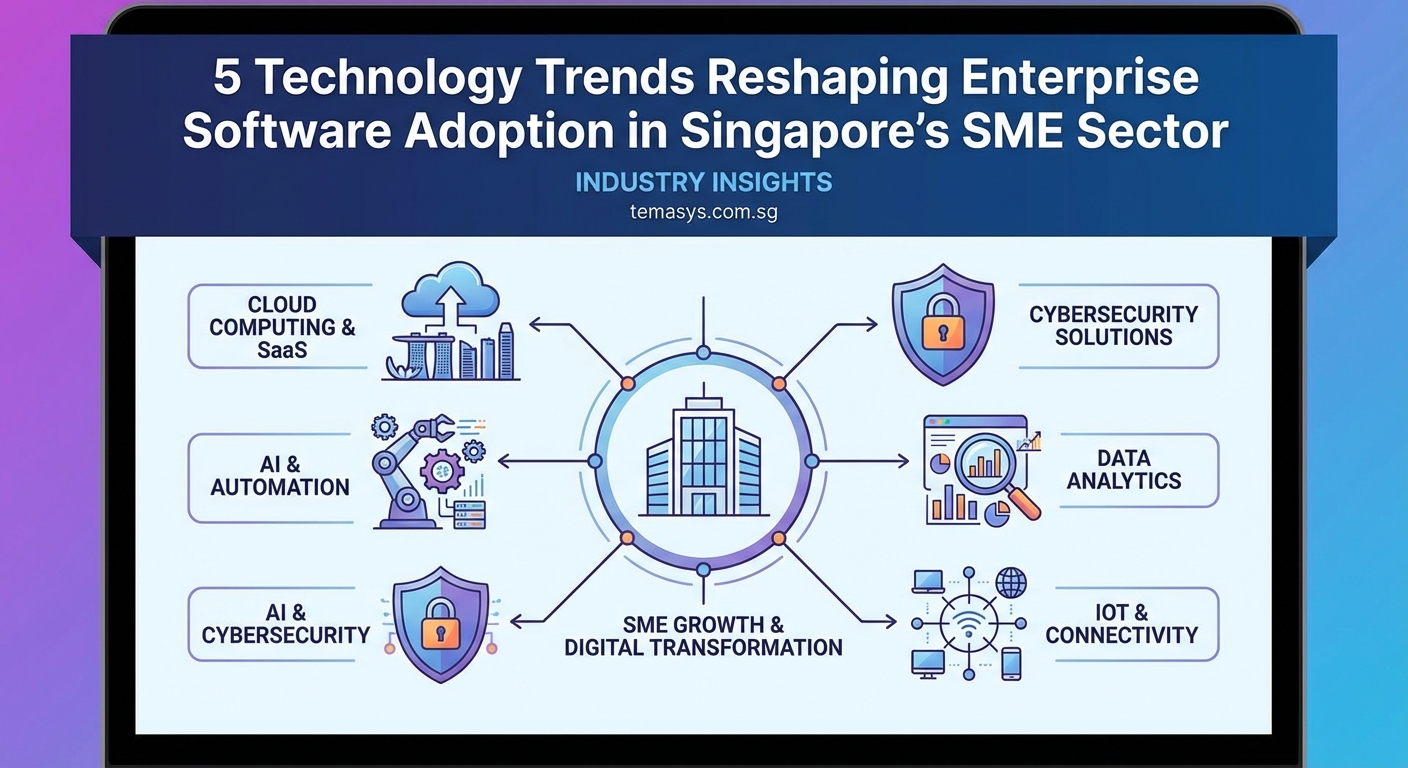
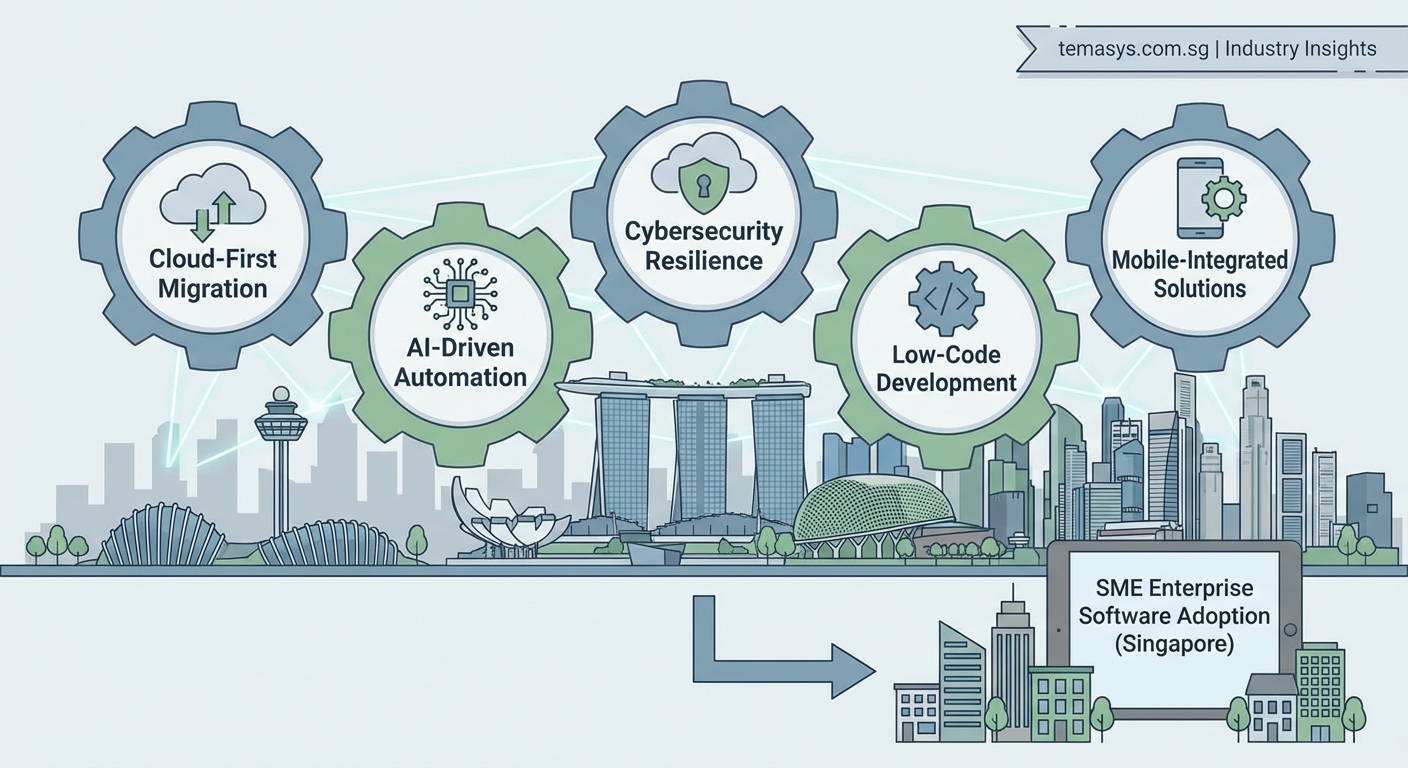
Singapore enterprises in 2025 are focusing on five core technology trends: AI-powered automation, cloud-first infrastructure, enhanced cybersecurity, low-code development, and data sovereignty. SMEs that adopt these trends strategically can improve efficiency by 30 to 40 per cent whilst maintaining competitive advantage. Success depends on choosing scalable solutions, training teams effectively, and aligning technology investments with business outcomes rather than chasing innovation for its own sake.
AI automation is becoming practical, not experimental
Three years ago, AI was mostly hype. Today, it’s solving real problems in Singapore SMEs.
The shift happened because AI tools became easier to implement. You no longer need a PhD to deploy machine learning models. Modern platforms handle the complexity behind simple interfaces.
Here’s what’s actually working for local businesses:
- Chatbots that handle 70 per cent of customer enquiries without human intervention
- Invoice processing systems that extract data from PDFs in seconds
- Predictive inventory management that reduces overstock by 25 per cent
- Automated report generation that saves finance teams 10 hours per week
The key difference in 2025 is specificity. Companies aren’t trying to “do AI.” They’re solving specific bottlenecks with targeted automation.
A manufacturing SME in Jurong recently implemented intelligent document processing transforming finance and hr operations in southeast asian enterprises to handle supplier invoices. The system now processes 500 invoices monthly with 98 per cent accuracy. Their accounts payable team shifted from data entry to exception handling and vendor relationship management.
That’s the pattern to watch. AI isn’t replacing entire departments. It’s removing the tedious parts of jobs so humans can focus on judgement and relationships.
“We’re not asking whether to adopt AI anymore. We’re asking which processes to automate first and how to measure the return. That’s a much healthier conversation.” — CTO of a 150-person logistics company
Cloud-first infrastructure is now the default choice
The cloud versus on-premise debate is essentially over for most SMEs. Cloud infrastructure won because it solves three problems simultaneously: upfront cost, scalability, and maintenance burden.
Singapore businesses are moving beyond basic cloud adoption. They’re now implementing hybrid and multi-cloud strategies that balance flexibility with control.
Here’s how the landscape looks in 2025:
| Infrastructure Model | Best For | Typical Use Case |
|---|---|---|
| Public cloud | Growing SMEs | SaaS applications, collaboration tools |
| Private cloud | Regulated industries | Financial data, healthcare records |
| Hybrid cloud | Enterprises | Core ERP on-premise, analytics in cloud |
| Multi-cloud | Tech-savvy firms | Best-of-breed services across providers |
The most successful implementations follow a clear migration path:
- Audit your current systems and identify dependencies
- Move non-critical applications first to build confidence
- Train your team on cloud management tools
- Migrate core systems during planned downtime windows
- Implement monitoring and cost controls from day one
One common mistake is underestimating ongoing cloud costs. A retail business migrated to AWS without proper monitoring and saw their monthly bill triple within six months. They eventually implemented cost allocation tags and automated shutdown policies for non-production environments, cutting costs by 40 per cent.
If you’re evaluating cloud erp vs on-premise which solution fits your singapore business, focus on total cost of ownership over five years, not just the first year’s subscription fees.
Cybersecurity is shifting from defence to resilience
Singapore SMEs are finally treating cybersecurity as a business priority, not an IT problem. The shift happened after several high-profile ransomware attacks hit local companies in 2023 and 2024.
The new mindset is resilience, not prevention. Companies assume breaches will happen and focus on minimising damage and recovery time.
Here’s what that looks like in practice:
- Zero-trust architecture that verifies every access request
- Automated backup systems with offline copies
- Incident response plans tested quarterly
- Security awareness training for all staff, not just IT
- Cyber insurance policies with clear coverage terms
The Cyber Security Agency of Singapore has been pushing the Cyber Essentials and Cyber Trust frameworks. Adoption is accelerating because customers and partners are asking for proof of security practices before signing contracts.
A distribution company lost access to their systems for three days after a phishing attack. They had backups, but no tested recovery process. The restoration took longer than necessary because no one had documented the dependencies between systems.
After the incident, they implemented a recovery plan and tested it monthly. When a second attack happened 18 months later, they were back online in four hours.
The lesson? Resilience comes from preparation, not just technology. Your security posture is only as strong as your team’s ability to respond under pressure.
Low-code platforms are democratising software development
The developer shortage in Singapore isn’t getting better. Salaries for experienced developers continue climbing, and hiring timelines stretch to six months or more.
Low-code platforms offer a practical alternative. They let business analysts and operations staff build applications without writing code.
The technology has matured significantly. Early low-code tools were limited to simple forms and workflows. Today’s platforms can handle complex business logic, integrate with existing systems, and scale to thousands of users.
Here are the most common applications:
- Customer onboarding portals that replace email-based processes
- Approval workflows that route requests automatically
- Inventory tracking systems tailored to specific operations
- Field service apps that work offline and sync when connected
The implementation process typically follows this pattern:
- Identify a high-volume, repetitive process that frustrates users
- Map the current workflow and pain points
- Build a prototype in the low-code platform
- Test with a small user group and iterate
- Roll out to the full team with training and support
A facilities management company used a low-code platform to build a maintenance request system. Previously, tenants emailed requests that got lost in inboxes. The new system routes requests automatically, tracks response times, and generates performance reports.
The entire application took three weeks to build. A custom-coded solution would have required six months and cost five times more.
The risk with low-code is creating shadow IT. Applications built outside IT oversight can create security gaps and integration nightmares. The solution is governance, not prohibition. Establish clear guidelines for when low-code is appropriate and require IT review before deployment.
If you’re considering low-code automation platforms empowering singapore s non-technical teams to streamline operations, start with a pilot project that has clear success metrics and a defined timeline.
Data sovereignty is becoming a competitive advantage
Singapore’s position as a regional hub makes data sovereignty both a challenge and an opportunity. Companies operating across ASEAN need to navigate different data protection regulations whilst maintaining operational efficiency.
The trend in 2025 is localising data storage and processing whilst maintaining centralised analytics. This approach satisfies regulatory requirements without creating data silos.
Here’s what’s driving the change:
- Personal Data Protection Act (PDPA) enforcement is increasing
- Customers are asking where their data is stored
- Cross-border data transfers face growing scrutiny
- Government contracts require local data residency
The practical implications vary by industry. Financial services and healthcare face the strictest requirements. Retail and logistics have more flexibility but still need clear data governance policies.
A regional e-commerce company restructured their infrastructure to store customer data in the country of origin whilst centralising product and inventory data in Singapore. This hybrid approach satisfied local regulations whilst maintaining operational efficiency.
The technical implementation involved:
- Database sharding by geography
- API gateways that route requests to the correct region
- Centralised identity management with federated authentication
- Regular audits to ensure compliance
The project took eight months and required significant investment. But it unlocked contracts with government agencies and large enterprises that wouldn’t work with vendors using offshore data storage.
For most SMEs, the practical approach is choosing vendors that offer regional data centres and clear data residency options. When evaluating digital transformation vendor selection red flags and green lights, ask specific questions about where data is stored and how it’s protected.
How to prioritise these trends for your business
Not every trend applies to every business. The key is matching technology investments to your specific challenges and growth stage.
Here’s a framework for deciding where to focus:
If you’re struggling with manual processes: Start with AI automation and low-code platforms. These deliver fast returns and don’t require replacing existing systems.
If you’re planning growth: Prioritise cloud infrastructure. It’s easier to scale cloud systems than on-premise ones, and you’ll avoid expensive hardware upgrades.
If you’re in a regulated industry: Focus on cybersecurity and data sovereignty first. These are table stakes for winning enterprise contracts.
If you’re replacing legacy systems: Consider how these trends affect your legacy system migration a step-by-step guide for singapore enterprises strategy. Modern platforms should support automation, cloud deployment, and data residency requirements.
The biggest mistake is trying to adopt everything at once. Pick one or two trends that address your most pressing problems. Implement them well. Then move to the next priority.
A professional services firm tried to modernise their entire technology stack in one year. They implemented new ERP, CRM, and collaboration tools simultaneously. The result was chaos. Staff couldn’t keep up with training. Data migration issues created errors. Productivity dropped for six months.
They eventually rolled back some changes and adopted a phased approach. Each system was implemented, stabilised, and adopted before moving to the next. The slower pace actually delivered results faster because changes stuck.
Making technology trends work for your organisation
The technology trends Singapore enterprises 2025 are adopting aren’t revolutionary. They’re practical solutions to common problems: too much manual work, inflexible systems, security risks, development bottlenecks, and regulatory complexity.
Your job as a business leader isn’t to chase every trend. It’s to identify which technologies solve your specific problems and implement them in ways your team can actually use.
Start with one trend that addresses your biggest pain point. Build a business case. Run a pilot. Measure results. Then scale or pivot based on what you learn.
The companies winning in 2025 aren’t the ones with the fanciest technology. They’re the ones that match the right tools to real problems and execute implementations that stick.
If you’re building a case for technology investment, consider how these trends affect building a business case for digital transformation cfo-approved framework. CFOs respond to clear ROI projections and risk mitigation strategies, not technology buzzwords.
The window for comfortable adoption is closing. The gap between digitally mature companies and laggards is widening. But there’s still time to catch up if you start now with focused, practical implementations.
Leave a Reply